post
Timber Floor Sanding Near Me: An Australian Homeowner’s Guide
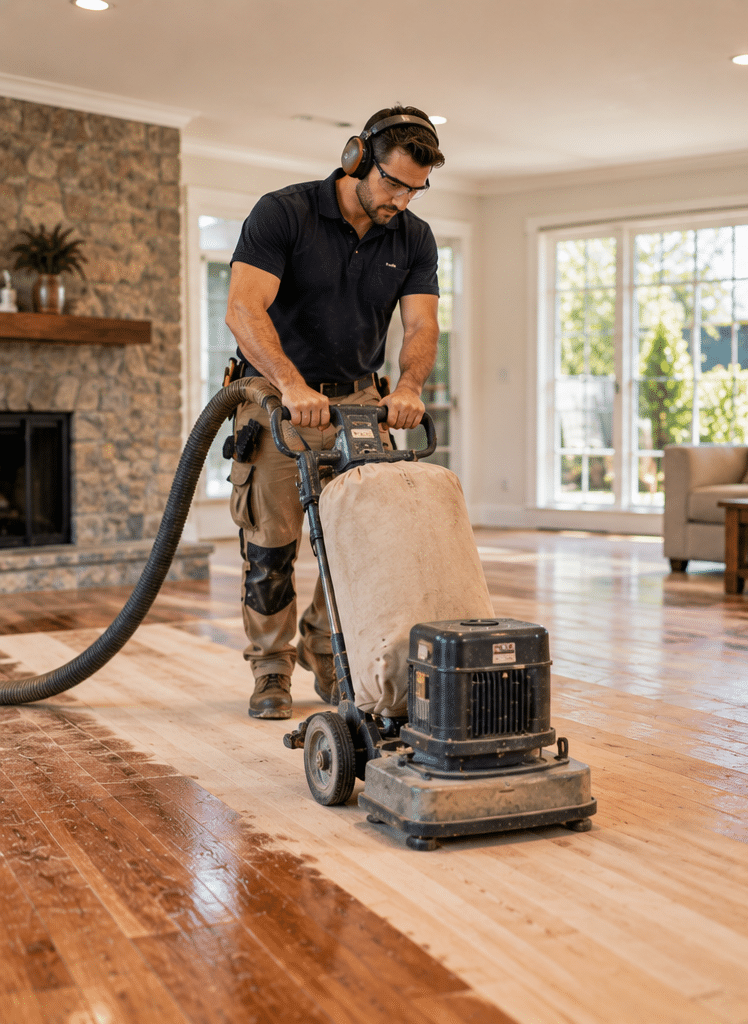
If you are searching for timber floor sanding near me, you are probably dealing with timber that looks scratched, dull, uneven, stained or simply older than the rest of your home. In Australia, professional floor sanding can often restore the appearance of suitable timber without replacing the entire floor. However, good results depend on much more than running a sanding machine over the boards. The floor needs to be assessed, prepared, sanded in stages and finished with a coating suited to the timber, site conditions and how the space is used.
A timber floor is also a natural building product. It responds to moisture, humidity, wear and temperature. Therefore, the contractor should look beyond surface scratches and consider what is happening in and beneath the boards before deciding how aggressively to sand.
In practice, the best floor-restoration decisions begin with one question: what does this particular floor actually need? Some floors need a complete sand-back. Others may only need repairs and recoating. Meanwhile, an engineered timber floor may have less material available for sanding than a traditional solid tongue-and-groove floor.
What Does Timber Floor Sanding Near Me Mean?
If you are searching for timber floor sanding near me in Australia, the service usually involves assessing the timber, repairing defects, machine-sanding old coatings and surface damage, edge/detail sanding, thorough dust removal, and applying a suitable protective finish. The right contractor should match the sanding and coating system to your floor’s condition and use.

Table of Contents
- What professional timber floor sanding includes
- How to tell whether your floor needs sanding
- Why Australian climate and moisture matter
- What happens during the sanding process
- Full sanding vs recoating vs repair
- How to choose a local timber floor sanding contractor
- What affects timber floor sanding prices
- Dust control and household safety
- Choosing a timber floor finish
- Common floor sanding mistakes
- People Also Ask about timber floor sanding near me
- Expert Q&A
- Conclusion
What Does Professional Timber Floor Sanding Actually Include?
Searching for timber floor sanding near me often brings up businesses offering “sand and polish”, “floor restoration”, “floor refinishing” and “floor recoating”. These terms overlap, but they do not necessarily describe the same amount of work.
Professional sanding generally removes part of the existing surface of the timber. This can remove an old coating, minor scratches, surface discolouration and some unevenness. The newly prepared timber can then receive another coating system.
The Australian timber-flooring industry has a specific technical framework for this work. AS 4786.2-2005 covers sanding and finishing of new and existing timber floors, including strip flooring and parquetry, and includes considerations such as moisture and coating systems. The current listing identifies the Standard as reconfirmed in 2016. You can review the AS 4786.2-2005 timber flooring overview for its scope.
Similarly, the Australian Timber Flooring Association describes professional preparation as including assessment of the floor, appropriate preparation, dust minimisation, sanding to produce a surface suitable for coating and careful application of the selected coating system.
Therefore, sanding is better understood as a floor-finishing system, rather than one isolated task.
A typical job may involve:
- checking the condition of boards;
- identifying loose, damaged or unsuitable areas;
- checking protruding nails or fixings;
- assessing moisture-related problems where relevant;
- removing or punching fixings as required;
- filling appropriate holes or defects;
- sanding the main floor area;
- sanding edges and corners;
- completing finer finishing passes;
- vacuuming and removing sanding dust;
- applying the specified coating or finish; and
- explaining curing and ongoing maintenance.
The exact sequence depends on the existing floor.
How Do I Know Whether I Need Timber Floor Sanding Near Me?
Not every imperfect timber floor needs to be fully sanded.
Before booking timber floor sanding near me, examine what you are actually trying to fix.
A full sand may be appropriate when:
The old coating is badly worn through in multiple places.
There are widespread scratches that extend beyond the coating.
The floor has substantial differences in surface appearance.
An old stain or finish needs to be removed before changing colour.
Repairs have left boards at slightly different surface levels.
The coating is peeling, deteriorating or otherwise unsuitable for a simple maintenance coat.
A full sand may not be necessary when:
The finish has only lost some sheen.
Wear is light and mainly affects the coating.
The existing coating is still well bonded and compatible with recoating.
There are only isolated marks that can be repaired separately.
In these cases, a professional may recommend a maintenance recoat instead.
That distinction matters because every complete sanding removes a small amount of timber. Solid timber floors generally provide more refinishing potential than products with a thinner timber wear layer.
What about engineered timber?
Engineered timber deserves extra care.
An engineered board normally consists of a real timber wear layer over one or more supporting layers. However, wear-layer thickness varies substantially between products.
Therefore, never assume an engineered floor can simply be sanded because the surface is timber.
The contractor should establish, as far as reasonably possible:
- the flooring product;
- remaining timber thickness;
- previous sanding history;
- depth of damage;
- location of joints and bevels; and
- manufacturer recommendations.
Aggressive sanding of a floor with insufficient usable timber can cause permanent damage.
Why Moisture Matters Before Timber Floor Sanding
Australian homeowners searching for timber floor sanding near me should understand one characteristic of timber above almost everything else: timber moves as its moisture content changes.
The Australian Timber Flooring Association explains that timber-flooring performance is affected by factors such as floor condition, moisture, preparation, sanding and coating. ATFA also notes that timber absorbs moisture under more humid conditions and releases moisture in drier conditions.
As moisture content rises, boards can swell.
As moisture content falls, boards can shrink.
Therefore, seasonal movement does not automatically mean that the floor has been installed or sanded incorrectly.
Why this matters before sanding
Imagine that boards have cupped because excess moisture is entering from underneath.
If the raised edges are immediately sanded completely flat without addressing the moisture problem, the boards may change shape again when their moisture levels stabilise.
Consequently, a responsible contractor should investigate unusual movement rather than treating every uneven board as a sanding problem.
ATFA’s specification for solid timber floors states that a floor should be assessed before sanding and that this assessment may include moisture assessment.
This is particularly relevant in Australia because conditions differ greatly between locations.
Brisbane and other humid South-East Queensland areas may experience prolonged periods of higher humidity. In contrast, inland areas can experience much drier conditions. Air conditioning, heating, ventilation, subfloor conditions and household occupancy can alter the internal environment again.
Therefore, the local climate is only one part of the assessment.
Timber Floor Sanding Near Me: What Happens During the Job?
When comparing timber floor sanding near me services, ask contractors to explain their process rather than simply asking how many days the project takes.
A professional sequence generally looks something like this.
1. Floor inspection
First, the contractor examines the timber.
They may identify:
- loose boards;
- damaged boards;
- exposed fixings;
- deep staining;
- cupping;
- gaps;
- previous coatings;
- repair areas; and
- moisture-related concerns.
This first stage determines whether sanding alone is appropriate.
2. Room preparation
Next, furniture and movable items are removed.
Curtains, electronics and sensitive belongings may also need protection depending on the site.
Doorways to unaffected areas may be isolated to reduce dust migration.
3. Repairs and fixing preparation
Loose boards, damaged sections and protruding nails generally need attention before major sanding begins.
Otherwise, sanding equipment can be damaged and defects may remain visible after finishing.
4. Initial sanding
The first machine passes remove the old finish and major surface imperfections.
However, contractors should not simply use the most aggressive abrasive possible.
The aim is to remove what is necessary while preserving as much useful timber as practical.
5. Intermediate and fine sanding
Subsequent sanding stages progressively refine scratches left by earlier abrasives.
This progression matters because the coating does not hide poor sanding preparation.
In fact, staining or applying finish can make inconsistent sanding more obvious.
6. Edge and detailed sanding
Large floor-sanding machines cannot reach every location.
Edges, doorways, corners and other restricted areas require separate equipment and careful blending.
Therefore, edge work is one area where workmanship becomes particularly visible.
7. Dust removal and inspection
Before coating, dust needs to be thoroughly controlled.
The surface is then inspected under suitable lighting before the finishing system begins.
8. Coating
The selected coating is applied according to its system requirements.
Different products have different:
- application methods;
- drying times;
- recoat windows;
- temperature limits;
- humidity limits; and
- curing requirements.
For example, recent ATFA guidance for waterborne finishes notes that manufacturers may specify particular temperature and relative-humidity ranges and that those instructions should be followed closely for reliable curing.
Therefore, a generic drying-time promise should never override the actual product specifications and site conditions.
Full Sand, Recoat or Repair: Which Option Fits Your Floor?
When researching timber floor sanding near me, it helps to separate three common services.
| Option | Best suited to | Main advantage | Main limitation |
| Full sand and refinish | Heavy coating wear, widespread scratches, colour changes or major surface restoration | Removes old finish and creates a newly prepared timber surface | Removes some timber and involves more downtime |
| Maintenance recoat | Sound floors with surface wear but no major timber damage | Less invasive and usually faster | Existing coating must be suitable for recoating |
| Repair plus refinishing | Loose, damaged or replaced boards combined with general wear | Addresses underlying defects before improving appearance | Scope and cost vary significantly with repair requirements |
A cheaper option is not automatically better.
Likewise, a complete sand is not automatically the premium solution.
The correct service is the least invasive option that reliably addresses the condition of the floor and your desired finish.
How to Choose Timber Floor Sanding Near Me in Australia
Typing timber floor sanding near me into Google may generate dozens of results. However, geographic proximity alone tells you very little about workmanship.
Use this numbered checklist before accepting a quote.
1. Confirm what type of floor you have
Ask whether the contractor regularly sands your flooring type.
Solid hardwood, softwood, parquetry and engineered timber can require different considerations.
2. Request an on-site assessment where practical
Photographs are useful for initial discussions.
However, photographs may not reveal loose boards, coating condition, floor flatness or moisture concerns.
3. Ask exactly what the quote includes
A quote should make clear whether it covers:
- repairs;
- filling;
- sanding;
- edging;
- coating;
- coating type;
- number of coats;
- stairs;
- furniture movement; and
- waste or cleanup.
4. Ask how dust will be controlled
Modern extraction systems can substantially reduce airborne and settled dust.
However, “dust-free” should not be interpreted as an absolute guarantee that no dust will exist anywhere.
Ask what equipment, extraction and room isolation will actually be used.
5. Ask which coating system is proposed
Do not accept “polyurethane” as the whole explanation.
Ask for the product or coating system, sheen, expected appearance and curing requirements.
6. Discuss colour before sanding begins
Removing an aged coating can reveal timber that looks different from the floor you have become accustomed to.
Furthermore, stains and coatings can change the apparent colour significantly.
Samples can therefore be helpful.
7. Discuss access and furniture
Find out which rooms need to be empty and when they can be entered again.
Also ask when rugs, furniture and normal foot traffic can safely return.
Dry-to-touch, walkable and fully cured do not necessarily mean the same thing.
8. Ask how damaged boards will be handled
A deep stain does not always disappear with sanding.
Likewise, water damage or structural defects may need repairs rather than progressively deeper sanding.
9. Clarify administrative requirements
If the project expands into installation, structural repairs or other building work, confirm whether any state-based licence or administrative requirements apply to that particular scope.
These are practical administrative checks, not legal advice.
10. Get the scope in writing
Finally, compare written scopes rather than only the final dollar amount.
Two quotes can appear to cover the same floor while including very different repair, preparation and coating work.
What Does Timber Floor Sanding Near Me Cost?
People searching for timber floor sanding near me naturally want a simple price per square metre.
However, publishing a single “Australian floor sanding price” can be misleading.
Labour, property conditions, floor type and coating systems differ between jobs and regions. Therefore, quotations should normally be based on actual scope.
Factors that can affect your quote include:
Floor area: Larger areas require more sanding, abrasives and coating.
Small-job minimums: A small room still involves travel, machinery setup, preparation and cleaning.
Floor condition: Heavy coatings, adhesives, uneven areas and deeply damaged surfaces can increase labour.
Repairs: Replacing boards or fixing movement is separate from cosmetic sanding.
Stairs: Stairs usually require detailed, labour-intensive work.
Edge complexity: Built-in cabinetry, narrow spaces and multiple doorways increase detail work.
Existing finish: Some coatings or residues take longer to remove.
Timber species: Different timbers can respond differently to abrasives, coatings and stains.
Desired colour: Staining generally creates extra preparation and application stages.
Coating system: Products vary in material cost, preparation and application requirements.
Access: Apartments, restricted parking, difficult equipment access or occupied buildings can affect logistics.
How to compare quotes fairly
Instead of asking:
“Who has the lowest square-metre rate?”
ask:
“What work does this rate actually include?”
For example, one quote might include minor fixing work, detailed edge preparation and a complete coating system.
Another might exclude those items.
Therefore, price comparisons should always be made on equivalent scope.
Dust Control and Safety During Timber Floor Sanding
Dust management should be part of every conversation about timber floor sanding near me.
Floor sanding is a woodworking activity, and sanding timber generates fine particles.
SafeWork NSW identifies hand and machine sanding as activities capable of producing airborne wood dust. Its guidance discusses controlling exposure through measures such as effective extraction and work practices. See the SafeWork NSW wood dust guidance for further information.
For homeowners, this means dust control is not simply about avoiding extra cleaning.
It is part of responsible worksite management.
Ask your contractor about:
- dust-extraction equipment;
- condition of sanding-machine dust systems;
- separation from occupied rooms;
- cleanup procedures;
- personal protective equipment used by workers; and
- ventilation requirements during finishing.
If anyone in the household has particular sensitivities, discuss them before the project begins.
Also remember that coatings have their own application and ventilation instructions.
Therefore, household re-entry should be based on the actual coating system used rather than an assumption that all finishes behave the same way.
Choosing the Right Finish After Sanding
A freshly sanded floor still needs protection.
Without a suitable finish, timber is more vulnerable to staining, wear and moisture exposure.
The coating also has a major effect on appearance.
Matt finishes
Matt coatings create relatively low light reflection.
They can suit contemporary interiors and may make everyday minor marks less visually prominent than a very glossy surface.
Satin finishes
Satin provides moderate sheen.
For many Australian homes, this offers a balance between a polished appearance and practical everyday presentation.
Gloss finishes
Gloss produces stronger reflection and can emphasise colour and grain.
However, stronger reflection can also make dust, scratches or surface variations easier to notice under certain lighting.
Waterborne systems
Modern waterborne coatings are commonly chosen where lower odour and faster drying characteristics are priorities.
Nevertheless, “water-based” does not mean every product has identical performance or curing requirements.
Always evaluate the complete coating system and manufacturer directions.
Staining
Staining changes the colour presentation of the timber.
However, stain results depend on:
- timber species;
- existing colour variation;
- sanding quality;
- previous contamination; and
- application technique.
Therefore, a small representative sample is often more useful than choosing colour from a screen.
Australian Climate, Timber Movement and Finished Floors
A professionally sanded timber floor is still timber.
Consequently, some seasonal movement can continue after refinishing.
ATFA explains that flooring responds to changes in relative humidity by taking up or releasing moisture. Solid timber can therefore expand under humid conditions and shrink in dry conditions.
This matters because homeowners sometimes assume a new coating permanently seals timber against seasonal movement.
It does not.
Coatings reduce direct surface exposure and provide protection, but timber remains responsive to its environment.
Normal maintenance therefore matters
Clean the floor using methods appropriate for its coating.
Wipe up spills promptly.
Avoid routinely flooding the floor during cleaning.
Use protective pads beneath furniture.
Keep abrasive grit and sand outside where possible.
Follow the coating manufacturer’s recommendations before placing rugs on newly finished surfaces.
Also, do not assume that a harder-looking finish allows unlimited abuse. Chairs, pet claws, grit and heavy objects can still mark a timber surface over time.
Common Mistakes When Looking for Timber Floor Sanding Near Me
Choosing solely on price
The cheapest quote may be appropriate, but price alone does not show how much preparation is included.
Compare scope first.
Assuming every scratch requires deep sanding
Some marks exist primarily in the coating.
Removing more timber than necessary does not provide an advantage.
Ignoring moisture problems
If the floor is cupping, lifting or showing unusual movement, investigate why before sanding aggressively.
Expecting every stain to disappear
Some stains penetrate deeper than the material that can reasonably be removed.
A contractor should explain this before work starts.
Assuming sanding is completely dustless
Effective dust containment can make a major difference.
However, realistic expectations are better than absolute claims.
Selecting a coating based only on sheen
Appearance matters, but durability, maintenance, drying conditions and intended use also matter.
Moving furniture back too soon
A coating may tolerate careful foot traffic before it is ready for rugs, heavy furniture or normal service.
Follow product-specific advice.
Sanding engineered timber without checking the wear layer
This can permanently damage a floor if insufficient real timber remains.
People Also Ask About Timber Floor Sanding Near Me
How long does timber floor sanding near me normally take?
The timeframe depends on floor area, repairs, sanding requirements and the selected coating system. A contractor should separate sanding time from coating, drying and curing time because these stages are not interchangeable.
Can I stay in my house during timber floor sanding?
Sometimes, although it depends on the areas being worked on, dust isolation, coating products and access routes. Ask the contractor which rooms will be unavailable and follow the coating manufacturer’s ventilation and re-entry instructions.
Can all timber floors be sanded?
No. Solid timber is commonly refinished, but engineered flooring has a limited wear layer and some floors may already have been heavily sanded. The remaining timber and overall condition should be assessed before proceeding.
Will timber floor sanding remove deep scratches?
Surface scratches and many moderate marks can often be reduced or removed during sanding. However, very deep damage may remain unless excessive timber is removed, so repair or board replacement can sometimes be a better option.
Expert Q&A: Timber Floor Sanding Near Me
1. Should gaps between timber boards be filled before sanding?
Not automatically.
Some gaps are related to normal seasonal movement. ATFA notes that board width changes as timber moisture content changes, so a gap visible during a dry period may reduce during more humid conditions.
Therefore, filling every seasonal gap with a rigid material can create other problems.
A contractor should first consider whether the gap is stable, seasonal, installation-related or associated with another defect.
2. Can floor sanding fix cupped timber?
Sanding can flatten the visible surface, but it does not remove the cause of cupping.
If excess moisture is responsible, moisture conditions should be investigated first. Otherwise, the boards may change shape after the moisture imbalance changes.
Therefore, moisture assessment can be more important than immediately making the boards look flat.
3. Is water-based polyurethane always better than solvent-based finishes?
Not in every application.
Waterborne products can offer advantages such as lower odour and different drying characteristics. However, product performance varies, and the correct coating depends on the timber, intended use, desired appearance, site conditions and maintenance expectations.
The important point is to compare complete coating systems rather than choosing solely from the words “water-based” or “solvent-based”.
4. How should I prepare my house before the floor sander arrives?
Remove furniture and personal items from the agreed work area.
Then confirm access, power requirements, dust-isolation arrangements, pets, alarms, doors, curtains and any items attached close to floor level.
Also ask when the area can safely be used again.
Preparing these details before work starts reduces interruptions and helps the contractor maintain a consistent sanding and coating sequence.
5. What should a good timber floor sanding quote tell me?
A useful quote should define the areas being treated, preparation, repairs or exclusions, sanding scope, coating system and expected access restrictions.
It should also identify any assumptions that could affect the price.
For example, hidden damage discovered after an old coating is removed may require additional approval.
Clear scope is more useful than a vague promise of a “complete floor restoration”.
Final Thoughts: Finding Timber Floor Sanding Near Me
Searching for timber floor sanding near me should be the beginning of your research, not the end of it.
A local contractor still needs to understand your timber, existing coating, floor condition, moisture behaviour and expectations.
First, establish whether the floor needs a full sand, maintenance recoat or repair.
Next, ask how dust will be controlled and which coating system will be used.
Then, compare written scopes rather than only comparing square-metre prices.
Most importantly, remember that timber is a natural material. Seasonal movement, colour variation and grain are part of its character. Good sanding does not turn natural timber into a manufactured sheet product. Instead, it prepares the surface carefully so the grain, colour and finish can perform well together.
Industry guidance supports this approach. Australian timber-flooring guidance calls for assessing the floor before sanding, completing suitable preparation, sanding it to a surface appropriate for the specified coating and providing ongoing-care information once the work is complete.
If you are in Brisbane or South-East Queensland and want to assess worn, scratched or ageing timber before deciding on the right restoration method, explore professional timber floor sanding and polishing services for your home or property. A proper assessment can help determine whether your floor needs complete sanding, targeted repairs, recoating or another treatment before work begins.