post
Floor Restoration Services in Australia: A Practical Guide to Restoring Timber Floors

Worn timber does not always need to be replaced. Professional floor restoration services can often bring scratched, faded, stained or tired timber floors back to a clean, durable and attractive condition. For Australian homeowners, landlords, facility managers and businesses, restoration can also preserve existing timber while addressing wear before it develops into more serious damage.
However, successful restoration is not simply a matter of running a sanding machine over the boards and applying a new coating. The contractor first needs to understand the timber, its condition, previous finishes, moisture exposure and how the space is used.
That assessment matters because timber is a natural material. It expands, contracts and responds to humidity. Australian hardwood species can also behave differently under changing environmental conditions.
Therefore, the best restoration plan is the one matched to the actual floor rather than a standard treatment applied to every project.
This guide explains what floor restoration involves, how to recognise when your floor needs attention, what professional contractors normally assess and how to make informed decisions before work begins.
What Are Floor Restoration Services?
Floor restoration services restore worn, scratched or aged floors by assessing damage, repairing defects, sanding or preparing the surface, and applying a suitable protective finish. For Australian timber floors, the goal is to preserve sound boards, improve appearance and durability, and avoid unnecessary replacement where the floor can be safely renewed.
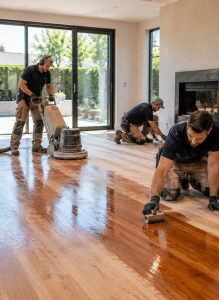
Table of Contents
- What floor restoration services actually include
- Why Australian timber floors need restoration
- Restoration versus recoating, repair and replacement
- Signs your timber floor may need restoration
- The professional floor restoration process
- Pre-restoration inspection checklist
- Different timber and flooring types
- Sanding and surface preparation
- Repairs before refinishing
- Choosing a floor finish
- Moisture and timber movement
- Floor restoration costs in Australia
- Dust control and worksite safety
- Residential and commercial restoration
- Common floor restoration mistakes
- Choosing a floor restoration company
- People Also Ask
- Floor restoration Q&A
- Conclusion
What Do Floor Restoration Services Actually Include?
Professional floor restoration services can include much more than sanding.
A restoration project may combine:
- surface inspection;
- moisture assessment where necessary;
- removal or resetting of protruding nails;
- board repairs;
- replacement of isolated damaged boards;
- filling selected gaps or holes where appropriate;
- sanding;
- edge sanding;
- fine surface preparation;
- stain application;
- recoating;
- polishing;
- protective finishing; and
- maintenance recommendations.
Importantly, not every floor needs every step.
A floor with a sound coating but mild surface wear may only need cleaning, light preparation and recoating. In contrast, a floor with deep scratches, an old coating and uneven wear may require full sanding and refinishing.
Meanwhile, damaged boards should usually be dealt with before the final finishing process. Otherwise, the restored coating may look attractive while the underlying defect remains.
The Australian Timber Flooring Association’s guidance states that floors should be assessed before sanding and that the assessment may include moisture considerations. It also notes that preparation can involve cleaning, dust minimisation and protection before sanding and coating.
For more technical information, see the Australian Timber Flooring Association specification for solid timber flooring.
Why Australian Timber Floors Need Restoration
Australian timber floors can be remarkably durable, but durability does not mean they are maintenance-free.
Everyday activities gradually affect the surface.
Chair legs can create scratches. Grit carried inside on shoes can act like abrasive material. Pet claws can mark some finishes. Direct sunlight can change timber colour. Meanwhile, high-traffic areas may lose their protective finish faster than corners and low-use rooms.
Moisture is another important factor.
Timber naturally exchanges moisture with the surrounding air. Therefore, seasonal humidity changes can cause movement in the boards.
This is particularly relevant in Australia because conditions vary considerably between coastal, tropical, dry inland and temperate regions.
WoodSolutions explains that timber flooring responds to changes in moisture and relative humidity. It also notes that regular maintenance is important and recommends dealing with spills promptly, controlling grit and following coating-manufacturer cleaning instructions.
Homeowners wanting to understand these principles in more detail can review the WoodSolutions timber flooring guidance.
Therefore, some gaps or minor seasonal movement do not automatically mean a floor has failed. An experienced contractor should first determine whether the condition is normal movement, coating wear, moisture damage or a more significant flooring problem.
Floor Restoration Services vs Recoating, Repair and Replacement
One of the most useful decisions is determining how much intervention the floor actually needs.
Not every worn floor needs complete restoration.
| Option | Best suited to | Typical work | Main limitation |
| Cleaning and maintenance | Dirt, light marks and intact coating | Appropriate cleaning and routine protection | Will not remove deep scratches or failed coatings |
| Recoating | Surface coating is worn but timber remains sound | Surface preparation followed by a fresh protective coat | May not correct deep damage or unevenness |
| Local floor repair | Isolated damaged, loose or defective boards | Repair or selective board replacement | Does not renew the entire surface |
| Full floor restoration | Widespread scratches, aged coatings, staining or uneven wear | Repairs, sanding, detailed preparation and refinishing | Requires greater preparation and downtime |
| Replacement | Structurally unsound, badly deteriorated or unsuitable flooring | Removal and new floor installation | Usually more disruptive than restoring sound timber |
This distinction matters financially as well as technically.
If the protective finish is beginning to wear but the timber has not been deeply damaged, timely recoating can sometimes delay the need for aggressive sanding.
On the other hand, applying another coating over a badly contaminated, deeply scratched or unsuitable surface may produce poor results.
Therefore, the condition of the floor should determine the treatment.
Signs You May Need Floor Restoration Services
There is rarely one single sign that tells you a complete restoration is required.
Instead, look at the overall condition.
1. Deep scratches
Very light scratches may exist only in the coating.
However, deeper scratches can penetrate through the finish and expose timber.
If scratches cover a large area, full surface restoration may be more practical than individual spot repairs.
2. Dull or patchy coating
Traffic routes often wear first.
For example, hallways, entry points, kitchens and living areas may become dull while areas underneath furniture retain more shine.
This contrast can indicate that the protective finish is becoming uneven.
3. Bare timber
Once protective coating has worn away, timber becomes more vulnerable to staining and moisture.
Therefore, exposed areas should not simply be ignored.
4. Water staining
A surface stain may sometimes be reduced through restoration.
However, persistent moisture problems must be identified first.
Sanding a floor without solving the source of moisture can result in the same issue returning.
5. Uneven boards
Sanding may correct small surface irregularities.
Nevertheless, cupping, crowning, lifting or movement can also be associated with moisture or installation conditions.
The underlying reason should therefore be investigated before aggressive sanding.
6. Old or failing coating
Peeling, widespread coating breakdown or areas that no longer protect the timber can indicate that refinishing is required.
7. Previous patch repairs no longer match
Older timber floors sometimes contain several generations of repairs.
Restoration can help create a more consistent overall appearance, although colour differences between old and replacement timber may remain visible.
Natural variation should be expected rather than treated as a defect.
The Professional Floor Restoration Process
Good floor restoration services usually follow a structured process.
The exact sequence varies with floor type, condition and finish. However, the following stages are common.
Stage 1: Inspection
First, the contractor examines the floor.
They may look at:
- timber type;
- floor construction;
- previous coating;
- scratches;
- stains;
- damaged boards;
- loose boards;
- nail positions;
- gaps;
- previous sanding;
- moisture indicators;
- access conditions; and
- high-traffic areas.
This stage is important because sanding removes material permanently.
Therefore, a contractor should understand the floor before deciding how aggressively it should be sanded.
Stage 2: Determine the required restoration level
Next, the contractor decides whether the floor needs:
- maintenance;
- recoating;
- spot repair;
- partial restoration; or
- full sanding and refinishing.
This can prevent unnecessary work.
Stage 3: Prepare the work area
Furniture normally needs to be removed from the restoration area.
Adjacent spaces may also require protection.
In addition, protruding nails and other surface hazards should be addressed before sanding begins.
Stage 4: Complete necessary repairs
Loose or badly damaged boards may require attention before the final surface is prepared.
Likewise, holes or selected defects may need filling.
However, filling every visible gap is not always appropriate because timber moves naturally.
Stage 5: Sand progressively
Professional sanding generally uses a progression from more aggressive abrasives to finer abrasives.
The first stages remove old finish and significant imperfections.
Subsequent stages refine the scratch pattern and prepare the surface for coating.
Edges and corners also require specialised attention because large floor machines cannot reach them.
Stage 6: Final surface preparation
Before coating, dust and contaminants must be removed carefully.
The quality of this stage directly influences the finish.
Small particles left behind can become visible once the coating is applied.
Stage 7: Apply the selected finish
The coating system is then applied according to product requirements.
Depending on the project, options may include water-based polyurethane or another coating system suitable for the timber and intended use.
The number of coats and preparation between coats depends on the chosen system.
Stage 8: Allow drying and curing
Dry and cured are not always the same thing.
A coating may become suitable for limited foot traffic before reaching full cure.
Therefore, homeowners should follow the coating manufacturer’s instructions and contractor advice regarding shoes, furniture, rugs and normal use.
Stage 9: Maintenance guidance
Finally, a good restoration service should explain how to care for the floor.
That advice helps protect the work and may reduce how frequently major restoration is required.
Numbered Checklist Before Booking Floor Restoration Services
Use this checklist before accepting a quotation:
- Identify the flooring type. Confirm whether the floor is solid timber, engineered timber, parquetry or another material.
- Ask what condition problems were found. These may include coating wear, scratches, moisture, damaged boards or previous sanding.
- Confirm whether full sanding is necessary. A recoat may be sufficient in some situations.
- Ask what repairs are included. Do not assume board repairs are part of a standard sanding quote.
- Discuss the finish system. Understand sheen level, colour, coating type and maintenance needs.
- Confirm site preparation requirements. Ask when furniture and belongings need to be removed.
- Discuss dust management. Ask what extraction and containment procedures will be used.
- Confirm access restrictions. Find out when people can enter the area again.
- Ask when furniture and rugs can return. Coating cure requirements may differ from initial drying.
- Request maintenance instructions. Proper cleaning and periodic maintenance can protect the restored finish.
Floor Restoration Services for Different Flooring Types
The correct method depends heavily on the floor.
Solid timber flooring
Solid timber is often well suited to restoration because the boards are timber throughout their thickness.
However, even solid timber cannot be sanded indefinitely.
Previous sanding may have already reduced the usable thickness.
Therefore, contractors should assess older floors carefully.
Common Australian timber species include Blackbutt, Spotted Gum and various ash and oak-style flooring products.
Species characteristics influence colour, hardness and moisture response.
Engineered timber
Engineered timber usually has a real timber wear layer over a manufactured core.
Some engineered floors can be sanded.
Others have a wear layer too thin for significant sanding.
Consequently, the product specification and remaining wear layer should be checked before work begins.
Assuming every engineered floor can be treated like solid timber can cause permanent damage.
Parquetry
Parquetry contains smaller timber pieces arranged into patterns.
Because grain direction changes across the pattern, sanding requires particular care.
Poor technique may leave scratches visible in different directions under light.
Timber decking
Outdoor timber faces additional exposure from sunlight, rain, temperature changes and dirt.
Deck restoration therefore differs from interior floor restoration.
Coating selection and preparation must suit exterior exposure.
Laminate flooring
Laminate should not be confused with solid or engineered timber.
Traditional laminate does not have a thick natural timber surface that can simply be sanded and refinished like hardwood.
Damaged laminate sections usually require a different repair or replacement strategy.
This is one reason why correct material identification comes before restoration.
Why Sanding Technique Matters
Sanding is one of the most visible parts of floor restoration services, yet the goal is not simply to remove as much timber as possible.
The objective is controlled material removal.
Aggressive sanding may be required where coatings or damage are substantial. However, unnecessary material removal reduces the amount of timber available for future restoration.
Furthermore, poor machine control can create:
- drum marks;
- waves;
- chatter;
- edge differences;
- swirl marks;
- uneven colour absorption; and
- visible sanding lines.
Fine sanding alone cannot always correct mistakes made during an earlier aggressive stage.
Therefore, each abrasive stage needs to remove the scratch pattern left by the stage before it.
Lighting also matters.
Marks that seem invisible during preparation may become noticeable once a coating changes the way light reflects from the surface.
This is particularly relevant in large rooms with strong windows or directional lighting.
Floor Repairs Before Restoration
Surface finishing cannot solve every flooring problem.
For example, sanding will not permanently correct a loose board.
Likewise, coating will not solve an active leak.
Professional floor restoration services may therefore include or recommend repairs before refinishing.
Possible repair work includes:
- resetting fixings;
- securing loose boards;
- replacing individual damaged boards;
- repairing local impact damage;
- correcting selected gaps where appropriate; and
- addressing damaged edges.
However, replacement timber may not immediately match the colour of decades-old flooring.
Age, sunlight exposure and coating history all influence colour.
Therefore, a perfect invisible repair should not automatically be expected.
A skilled restoration contractor should discuss these limitations before work starts.
Choosing a Finish During Floor Restoration
Once the surface has been restored, the protective coating becomes the working layer that faces everyday wear.
Choosing it should involve more than selecting the gloss level.
Consider:
- expected traffic;
- residential or commercial use;
- cleaning requirements;
- desired appearance;
- coating maintenance;
- drying and curing requirements; and
- manufacturer recommendations.
Matt finish
Matt finishes produce relatively low light reflection.
They can suit contemporary interiors and may make some minor surface marks less visually obvious.
Satin finish
Satin sits between matt and gloss.
As a result, it is a popular option where homeowners want some reflected light without a highly glossy appearance.
Gloss finish
Gloss provides stronger reflection and can produce a more traditional polished appearance.
However, reflected light may also make scratches, dust or surface imperfections easier to notice.
There is no universally “best” sheen.
The right choice depends on the room, lighting, floor character and personal preference.
Moisture and Floor Restoration Services
Moisture deserves special attention because timber is hygroscopic.
In simple terms, it exchanges moisture with the surrounding environment.
As humidity changes, timber can expand or contract.
WoodSolutions notes that relative humidity is a major influence on floor movement and explains that moisture conditions need to be considered when assessing timber flooring.
Therefore, a contractor may investigate moisture when a floor shows:
- cupping;
- unusual expansion;
- lifted boards;
- widespread gaps;
- staining; or
- unexplained coating problems.
The important point is that visible symptoms should not automatically be sanded away.
If moisture is still affecting the timber, the underlying condition needs to be stabilised first.
For example, a leaking appliance should be repaired before refinishing the surrounding floor.
Likewise, subfloor moisture or ventilation concerns may need separate investigation.
Restoring timber too early can hide symptoms without resolving their cause.
How to Maintain a Restored Timber Floor
After professional floor restoration services, everyday habits influence how well the new finish performs.
WoodSolutions recommends regular cleaning, quick attention to spills and reducing grit that can scratch the surface. It also advises against steam mops on timber flooring.
Practical care includes using suitable entrance mats and keeping them clean.
In addition, place protective pads underneath chairs and furniture that move frequently.
Vacuum attachments should also be appropriate for hard flooring.
Meanwhile, avoid flooding the timber with water during cleaning.
More water does not mean a cleaner timber floor.
Instead, follow the coating manufacturer’s cleaning recommendations.
Another useful habit is inspecting busy areas before the coating is completely worn through.
A maintenance recoat can sometimes renew protection without the heavier material removal associated with complete sanding.
Consequently, preventive maintenance is often more efficient than waiting until bare timber appears.
What Do Floor Restoration Services Cost in Australia?
There is no reliable single national price for floor restoration services.
A quotation depends on the actual work required.
Major cost factors include:
- floor area;
- timber type;
- existing coating;
- surface condition;
- amount of sanding;
- board repairs;
- stairs and detailed edges;
- accessibility;
- furniture removal requirements;
- staining;
- coating system;
- number of coats;
- commercial scheduling; and
- location.
Therefore, price-per-square-metre comparisons can be misleading if two quotations include different levels of preparation.
For example, one quote may cover sanding and coating only.
Another may include repairs, nail preparation, staining, detailed edging and additional coating work.
Instead of choosing a contractor based only on the final figure, compare the scope.
Ask what preparation is included, which coating system will be used and whether repairs are separately charged.
That creates a more meaningful comparison.
Dust Control and Safety During Floor Restoration
Sanding produces fine material.
Therefore, professional dust management is an important part of modern floor restoration services.
Safe Work Australia identifies wood dust produced during activities such as cutting, sanding and machining as a workplace hazard.
You can read the national guidance through the Safe Work Australia information on carcinogen and wood-dust hazards.
Professional contractors may use extraction systems connected to sanding equipment, work-area isolation, suitable cleaning procedures and personal protective equipment as required.
However, consumers should be cautious about absolute phrases such as “completely dust-free”.
No sanding process should automatically be assumed to create literally zero dust.
Instead, ask what equipment and controls are used to minimise airborne and settled dust.
For commercial properties, worksite arrangements may also involve workplace health and safety requirements.
Those checks are administrative and operational matters and should be reviewed against the rules that apply in the relevant Australian state or territory; they are not legal advice.
Residential Floor Restoration Services
Residential restoration needs to account for how a household actually uses the home.
A family home may involve:
- children;
- pets;
- heavy dining chairs;
- direct sunlight;
- frequently used hallways;
- kitchen spills; and
- furniture that cannot remain off the floor for long periods.
Therefore, coating choice and scheduling should fit the household rather than focusing only on appearance.
Homeowners should also discuss access during coating and curing.
If bedrooms, bathrooms or exits are located beyond the restoration zone, a staged approach may occasionally be necessary.
Planning this before work starts can avoid practical problems later.
Commercial Floor Restoration Services
Commercial projects often have different priorities.
Appearance still matters, but downtime may be equally important.
Restaurants, retail stores, schools, halls, offices and community facilities can experience concentrated traffic patterns.
Consequently, the restoration plan may need to consider:
- opening hours;
- customer access;
- work zones;
- higher traffic;
- cleaning routines;
- furniture or equipment movement;
- coating durability; and
- reopening schedules.
The cheapest initial option is not necessarily the lowest-cost long-term option.
A finish that requires frequent interruption for maintenance may be unsuitable for a heavily used facility.
Therefore, contractors should understand how the building operates before recommending a system.
Common Mistakes When Restoring Timber Floors
Sanding before understanding moisture
This can remove visible symptoms without solving the problem behind them.
Instead, unusual movement or water damage should be investigated first.
Waiting until large areas are bare
Once the protective coating has worn away, timber is more exposed.
Earlier maintenance may reduce the need for aggressive future sanding.
Choosing a contractor only by price
Preparation quality can differ significantly.
Therefore, quotations should be compared by scope as well as cost.
Assuming every scratch needs full sanding
Some light coating damage may be manageable through less intensive maintenance.
An inspection helps determine what is actually necessary.
Expecting old timber to look completely uniform
Timber contains natural colour and grain variation.
Repairs and old boards may also age differently.
A quality restoration should improve the floor while preserving its natural character rather than making timber look artificially identical.
Moving furniture back too early
Initial surface dryness does not necessarily mean the coating has completed its curing process.
Always follow the specified return-to-service instructions.
Using unsuitable cleaning products afterwards
Some household products can leave residue or affect floor finishes.
Use cleaning methods recommended for the actual coating system.
How to Choose Floor Restoration Services in Australia
A reliable contractor should be willing to explain why a particular treatment is recommended.
Ask what they see during the inspection.
For example:
Is the wear mainly in the coating?
Has the timber itself been damaged?
Does the floor appear suitable for another sanding?
Are moisture readings needed?
Will individual boards need repair?
Which coating system is proposed?
How long should the floor remain free of furniture?
Good answers should be specific to your property.
Be cautious if a contractor recommends the same restoration package before properly examining a complex or badly damaged floor.
Likewise, be cautious about guaranteed claims that every stain, dent or mark will disappear.
Some damage runs too deeply into timber to remove without taking away excessive material.
Professional restoration involves judgement.
Sometimes preserving a small imperfection is better than over-sanding the entire floor trying to eliminate it.
People Also Ask About Floor Restoration Services
How much do floor restoration services cost in Australia?
There is no single Australian price because floor size, timber condition, repairs, access and coating choice all affect the scope. A site-based quote is generally more useful than comparing headline square-metre rates without checking what each contractor includes.
Is it cheaper to restore timber floors or replace them?
Restoration can often be more economical when the existing boards are structurally sound. However, widespread rot, severe structural damage, insufficient remaining timber or an unsuitable floor system can make partial or full replacement more appropriate.
How long does floor restoration take?
Many projects require several stages, including preparation, sanding, coating and curing. Consequently, the total schedule depends on floor size, repairs, coating system, environmental conditions and how quickly the space must return to service.
Can badly scratched timber floors be restored?
Often, yes. Sanding can remove many surface scratches where sufficient timber remains, although extremely deep damage may not disappear completely. The contractor should balance appearance improvement against unnecessary removal of timber.
How often should timber floors be restored?
There is no universal restoration interval. Traffic, pets, grit, sunlight, coating type and maintenance all affect wear, so periodic inspection is more useful than following a fixed number of years.
Expert Q&A About Floor Restoration Services
1. Can floor restoration fix timber after water damage?
Sometimes, but restoration should not begin until the cause and extent of moisture exposure are understood.
Timber may change shape while absorbing and releasing moisture. Therefore, sanding a floor while it is still moving can produce poor results. The moisture source should first be corrected, and the flooring should be appropriately assessed before deciding whether sanding, repair or replacement is suitable.
2. Can an old timber floor be sanded too many times?
Yes.
Each full sanding removes a small amount of timber. Eventually, an older floor may have limited material remaining above joints or fixings.
Therefore, previous sanding history and remaining board condition should be assessed.
In some cases, recoating or targeted repair may preserve an old floor better than another aggressive sand.
3. Can floor restoration remove every stain?
No.
Some staining sits mainly at the surface and may improve significantly after sanding.
However, stains that have penetrated deeply into the timber may remain visible.
Trying to remove a deep stain completely could require excessive material removal.
For that reason, contractors may recommend accepting some natural character, replacing an isolated board or using another treatment rather than over-sanding the whole area.
4. Can floor restoration stop squeaking?
It depends on the cause.
A squeak may come from board movement, fixings, the subfloor or interaction between flooring components.
Surface sanding alone does not fix those underlying conditions.
Therefore, the source should be investigated before the floor is refinished. Some local fastening or board repairs may be completed during restoration, while structural causes may require separate work.
5. Should I choose matt, satin or gloss after restoration?
Choose the sheen according to the appearance and maintenance expectations of the room.
Matt reflects less light and can create a softer appearance. Satin offers moderate reflection and works well in many interiors. Gloss produces stronger reflection but may make dust and surface marking more noticeable.
The coating system and performance requirements should be considered alongside sheen.
A Practical Approach to Long-Term Floor Care
One of the strongest lessons in timber-floor maintenance is that earlier intervention is often simpler than major restoration after years of neglect.
For instance, grit removal sounds insignificant compared with sanding.
Yet grit under shoes and furniture repeatedly abrades the protective coating.
Likewise, wiping a spill quickly is much easier than dealing with moisture staining later.
Therefore, floor care should be viewed as a cycle:
protect, inspect, maintain, recoat when appropriate and restore only when needed.
That approach preserves more timber.
It can also reduce disruption because full sanding may be required less frequently.
From a practical restoration perspective, the most attractive floor is not necessarily the floor with every mark removed. Instead, the better result is usually a sound floor with a well-prepared surface, appropriate protection and enough timber retained for its future life.
Why Assessment Comes Before Sanding
Homeowners searching for floor restoration services often focus immediately on the final colour or shine.
However, the most important decisions happen before the coating tin is opened.
The contractor needs to decide:
What is causing the wear?
Is there moisture?
Is the existing coating compatible with the proposed treatment?
Can the boards safely be sanded?
Are repairs needed?
Will a recoat achieve the required result?
Only then should sanding and coating choices be finalised.
This is consistent with Australian industry guidance, which places assessment and preparation before sanding and finishing.
Consequently, a detailed inspection is not an unnecessary extra step.
It is part of protecting the timber.
Conclusion: Choosing Floor Restoration Services That Protect Your Timber
Quality floor restoration services should do more than make a timber floor look shiny again.
The process should begin with understanding the floor, identifying the causes of wear and deciding how much intervention is genuinely required.
For some floors, that means a maintenance recoat.
For others, it means repairs, progressive sanding and a complete new finish.
Meanwhile, floors affected by moisture, structural movement or extensive deterioration may require additional work before cosmetic restoration is appropriate.
Australian timber floors also respond to their environment. Therefore, humidity, water exposure, species, traffic and maintenance history all influence the final restoration plan.
When comparing contractors, focus on assessment quality, preparation, repair scope, dust management, coating specifications and after-care guidance—not simply the lowest price.
Most importantly, avoid unnecessary replacement when sound timber can be responsibly renewed.
For homeowners, businesses, schools and facilities in South-East Queensland, you can explore professional timber floor restoration services from Enviro Floors and arrange an assessment based on the actual condition and use of your floor.
A well-restored timber floor should not simply look renewed on handover day. With appropriate preparation, finishing and ongoing maintenance, it should remain practical, attractive and easier to care for well into the future.