post
Timber Floor Repairs Near Me: A Practical Australian Guide
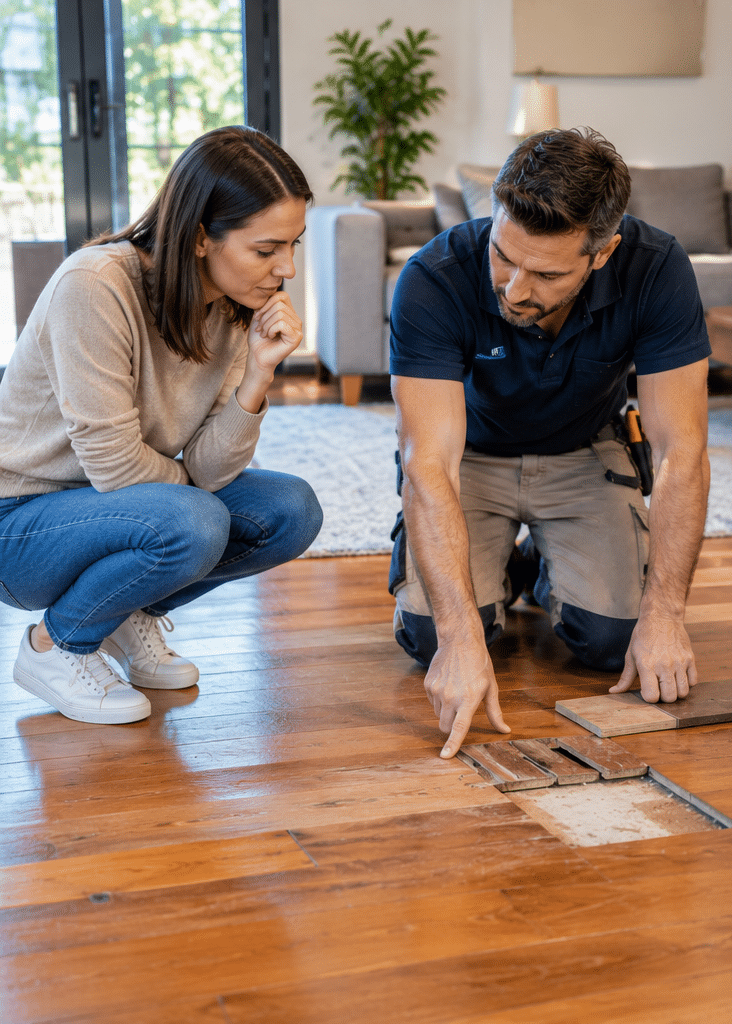
Searching for timber floor repairs near me usually means something has changed in your floor that you can no longer ignore. You may have damaged boards, deep scratches, gaps, squeaks, water marks, worn coatings or sections that feel uneven underfoot. Fortunately, many timber-floor problems can be repaired without removing and replacing the entire floor.
Timber is a natural material. Therefore, it responds to changes in moisture, humidity, wear and the conditions inside a building. A small gap does not always mean the floor is failing. Likewise, a scratched coating does not necessarily mean the timber itself is damaged.
The important first step is identifying the cause before choosing a repair.
In practical timber restoration work, this distinction matters. Repairing the visible symptom without addressing its cause can allow the same problem to return. For example, replacing a moisture-damaged board before finding the source of the moisture could simply damage the new board as well.
What Does Timber Floor Repairs Near Me Mean?
“Timber floor repairs near me” is a local search for a flooring specialist who can diagnose and repair damaged boards, scratches, gaps, moisture-related movement, squeaks, coating failure or localised wear. The correct repair depends on whether the problem is cosmetic, board-level, installation-related, moisture-related or linked to movement beneath the floor.

Table of Contents
- What timber floor repairs actually involve
- Why timber floors become damaged
- When to call a local flooring specialist
- Repair, sanding or replacement: which is right?
- How timber floor damage is assessed
- Checklist for choosing timber floor repairs near me
- Moisture and timber floor movement
- Repairing individual damaged boards
- Scratches, dents, stains and coating damage
- Gaps, squeaks and loose floorboards
- Sanding and refinishing after repairs
- How much timber floor repair costs
- Choosing a qualified timber flooring contractor
- What to prepare before requesting a quote
- Preventing future timber-floor damage
- People Also Ask
- Expert Q&A
- Conclusion
What Do Timber Floor Repairs Actually Involve?
When people search for timber floor repairs near me, they are often looking for one service. In reality, timber-floor repair can involve several different processes.
A repair may be as simple as correcting a damaged coating. However, another floor may require individual boards to be removed and replaced. A third property may have moisture-related movement that must be investigated before cosmetic work begins.
Common timber-floor repair work can include:
- replacing cracked or badly damaged boards;
- repairing or reducing visible scratches;
- resetting protruding nails or fixings;
- treating loose boards;
- correcting localised gaps where appropriate;
- repairing damaged parquetry;
- addressing surface staining;
- sanding repaired sections;
- blending repaired boards into the surrounding floor;
- recoating worn timber;
- correcting minor surface irregularities; and
- preparing damaged floors for broader restoration.
The Australasian Timber Flooring Association, or ATFA, explains that timber floors naturally experience some expansion and shrinkage through the year. It also notes that repair, readjustment, sanding and recoating are accepted remedial approaches for many flooring problems.
That is important because damage does not automatically mean replacement.
In many cases, repairing a sound existing timber floor can preserve far more of the original material.
For consumer guidance, see the ATFA consumer information on timber flooring.
Why Timber Floors Become Damaged
A useful answer to timber floor repairs near me starts with understanding why damage occurred.
Timber floors can last for many years. However, their appearance and performance depend on installation, building conditions, maintenance, moisture exposure and traffic.
Everyday wear
Foot traffic gradually wears protective coatings.
Entryways, kitchens, hallways and living rooms usually show signs first because they experience more movement. In commercial buildings, traffic can be considerably heavier.
Eventually, the finish may become dull or scratched even though the underlying board remains structurally sound.
In that situation, the solution may be maintenance or recoating rather than replacing floorboards.
Furniture scratches
Furniture that moves directly across a timber floor can scratch the finish.
Dining chairs are a common example. Sand or grit trapped beneath furniture legs can make the problem worse because those particles act like an abrasive.
Shallow scratches may affect only the coating. Deep scratches, however, can enter the timber itself.
Therefore, depth matters when deciding how to repair them.
Impact damage
Dropping a heavy object can create:
- dents;
- chips;
- cracks;
- compressed timber fibres; or
- broken board edges.
Whether the board needs replacing depends on the extent and location of the damage.
Water exposure
Water is one of the more important issues to investigate.
A leak from plumbing, appliances, roofing or doors can expose timber to moisture. Depending on the circumstances, boards may swell, cup, stain or move.
Importantly, cosmetic restoration should not start until the source has been identified and controlled.
Otherwise, the problem may return.
Changes in indoor conditions
Timber responds to its surrounding environment.
ATFA advises consumers to expect some natural expansion and shrinkage effects because timber moves as environmental conditions change.
Consequently, not every seasonal gap requires repair.
The key question is whether the movement is normal or indicates a broader problem.
Previous repairs or sanding
An older floor may have been repaired several times.
It may also have been sanded in the past. Therefore, a flooring specialist should understand the remaining condition of the boards before recommending aggressive sanding.
This is particularly important with older floors and engineered products.
When Should You Look for Timber Floor Repairs Near Me?
Some surface wear can wait. Other problems deserve faster inspection.
Consider arranging an assessment when you notice:
- floorboards that feel unstable;
- broken or splintering boards;
- sudden or unusually large gaps;
- boards lifting from the surrounding floor;
- significant cupping or distortion;
- moisture staining;
- recurring black or dark marks after water exposure;
- deep scratches through the coating;
- loose parquetry blocks;
- extensive squeaking that has recently developed; or
- coating that is peeling or separating.
However, diagnosis should come before treatment.
For example, a squeak can arise from movement between components. A visible gap may reflect seasonal timber movement. Meanwhile, a raised board near a leaking doorway could point to moisture.
Those conditions should not automatically receive the same repair.
Timber Floor Repair vs Sanding vs Replacement
People searching for timber floor repairs near me often wonder whether they need a repair, sanding or a completely new floor.
The following comparison explains the difference.
| Option | Usually Suits | Typical Work | Main Advantage | Important Limitation |
| Localised repair | A few damaged boards, isolated cracks, loose sections or small defects | Repair or replace affected material | Preserves most of the existing floor | Matching old timber can require care |
| Sand and refinish | Widespread scratches, tired coatings or surface wear | Sand surface and apply a new finish | Restores a large area consistently | Cannot solve an active moisture problem |
| Recoat | Coating is worn but timber remains relatively sound | Prepare existing finish and apply compatible coating | Less invasive than full sanding | Not suitable for every coating condition |
| Individual board replacement | Boards are split, badly stained or physically damaged | Remove damaged board and install matching material | Targets serious local damage | Colour differences may initially remain |
| Full replacement | Extensive structural or moisture damage, or floor beyond practical repair | Remove and install flooring | Creates a completely new floor | Highest level of disruption and material use |
Therefore, the most expensive solution is not automatically the best solution.
A competent assessment should determine how much sound flooring can be retained.
How a Professional Timber Floor Assessment Works
A professional inspection for timber floor repairs near me should involve more than looking at the scratch or broken board.
The surrounding floor matters too.
1. Identify the flooring type
The contractor first needs to determine what is installed.
For example, the floor may be:
- traditional solid tongue-and-groove timber;
- engineered timber;
- parquetry;
- overlay flooring; or
- another timber-based system.
Different constructions can require different repair methods.
2. Inspect the damaged area
Next, the contractor should determine whether the defect affects:
- the finish only;
- the timber surface;
- the entire board;
- several adjoining boards;
- fixings;
- the substrate or support beneath the floor.
This prevents unnecessary work.
3. Look for moisture
Where staining, cupping, swelling or recent movement is present, moisture deserves attention.
The repair should address the source rather than simply covering the visible damage.
4. Check surrounding boards
A damaged board rarely exists in complete isolation.
Nearby boards can show whether the issue is spreading, stable or related to local impact.
5. Consider previous sanding
Older floors may already have lost some thickness through previous sanding.
Therefore, sanding history can affect the restoration strategy.
6. Decide how the finish will be blended
Installing a sound replacement board is only part of the job.
The new section must also work visually with the existing floor.
Species, colour, age, finish and exposure to sunlight can all affect the final appearance.
Numbered Checklist: Choosing Timber Floor Repairs Near Me
When comparing providers after searching for timber floor repairs near me, use this checklist before booking work.
- Describe the actual problem.
Explain whether you have scratches, water damage, gaps, loose boards, broken timber, squeaks or coating failure. - Ask for an inspection where appropriate.
Photos can help with an initial discussion, but complex damage may need an onsite assessment. - Ask whether the underlying cause has been identified.
This is especially important with moisture, repeated movement or recurring damage. - Confirm what will be repaired.
Your quote should distinguish board repairs, sanding, coating and other preparation. - Ask how replacement timber will be matched.
Species, dimensions, profile and appearance can matter. - Discuss the finish.
Ask how repaired areas will be blended with the existing coating or whether a larger area needs refinishing. - Check licence requirements for your location and scope.
Requirements differ according to jurisdiction and type of work. - Ask about insurance and workmanship arrangements.
Keep written quotations, specifications and agreed scope documents. - Discuss access and drying or curing time.
This helps you plan furniture removal and use of the room. - Get the repair method in writing.
A clear scope makes it easier to understand what is included before work begins.
Why Moisture Matters in Timber Floor Repairs
Moisture deserves its own section because it can dramatically change the correct repair.
If you search for timber floor repairs near me after noticing boards lifting, cupping or changing shape, do not assume sanding is the first step.
The floor may still be responding to moisture.
For example, moisture can come from:
- plumbing leaks;
- wet areas;
- water entering through doors;
- roofing problems;
- damp subfloor conditions;
- flooding;
- cleaning with excessive water; or
- other building moisture issues.
However, the visible floor may not reveal the full cause.
Therefore, drying conditions and the moisture source should be investigated before final restoration begins.
This principle also explains why some gaps should not be immediately filled.
If a seasonal gap is filled while the floor is relatively dry, later expansion may create unwanted pressure when environmental conditions change.
ATFA reminds consumers that timber is natural and some seasonal expansion and shrinkage should be expected.
Consequently, experienced assessment is more useful than treating every visible gap as a defect.
Repairing Individual Damaged Timber Floorboards
Individual board replacement is one of the most useful techniques in timber restoration.
Rather than removing a whole room, a contractor may be able to replace only the damaged section.
ATFA’s technical guidance demonstrates a damaged-board replacement process that involves locating fixings, carefully cutting out the affected board, preparing a replacement, providing appropriate support and securing the replacement without damaging surrounding boards.
You can review its practical overview in the ATFA guide to replacing a damaged timber floorboard.
Why board matching matters
The replacement should be selected with attention to:
- board width;
- thickness;
- species;
- profile;
- grain;
- grade; and
- existing floor construction.
However, even a technically suitable replacement can initially look different.
Old timber has experienced years of light, wear, cleaning and coating changes. Fresh timber has not.
Therefore, some colour variation can be normal until the repair ages.
Why the surrounding boards matter
Removing a damaged board requires care because the neighbouring boards should remain intact.
This is why a professional repair is often more involved than simply cutting out visible damage.
The repair also needs sufficient support and a suitable fixing method.
Scratches, Dents and Surface Damage
A search for timber floor repairs near me is often triggered by visible marks rather than structural problems.
Fortunately, surface damage can sometimes require less invasive restoration.
Light scratches
If a scratch remains within the protective coating, the timber may still be intact.
Depending on the finish and condition, professional preparation and recoating may be possible.
Deep scratches
A scratch that enters the wood is different.
Sanding, colour adjustment and refinishing may be required.
If there are many deep scratches across the room, treating each mark individually may create an inconsistent result. Therefore, broader sanding and refinishing may produce a better appearance.
Dents
A dent is usually compressed timber rather than missing timber.
Its repairability depends on depth, species, finish and board condition.
Some dents may remain visible after normal refinishing. Consequently, severely damaged boards sometimes make better candidates for replacement.
Stains
Surface stains and deep timber stains should not be confused.
If staining has entered the timber, simply applying a new coating will not necessarily hide it.
The cause should also be established. This is particularly important if water caused the mark.
Can Water-Damaged Timber Floors Be Repaired?
Sometimes.
However, the answer depends on severity.
A small area affected by a short-lived incident may be repairable once the floor and surrounding building materials are properly assessed.
By contrast, prolonged or repeated moisture exposure can create a larger problem.
Possible signs include:
- cupping;
- swelling;
- staining;
- board movement;
- coating failure;
- lifting sections; and
- movement at joins.
Therefore, do not focus only on appearance.
When requesting timber floor repairs near me for water-related damage, tell the contractor:
- where the water came from;
- approximately when the event occurred;
- whether the source has been fixed;
- how long the area remained wet; and
- whether the boards are continuing to change.
That information can improve the assessment.
Gaps Between Timber Floorboards
Gaps are one of the most misunderstood timber-floor issues.
Because timber responds to environmental conditions, a small change between boards can occur without indicating serious damage.
ATFA specifically advises homeowners that timber movement and seasonal expansion and shrinkage should be expected.
Therefore, the first question is not simply, “How do we fill this gap?”
Instead, ask:
Why is the gap there?
A flooring specialist may consider:
- whether the gaps are seasonal;
- whether they occur throughout the floor;
- whether only one section is affected;
- the age of the installation;
- surrounding environmental conditions; and
- whether boards have physically moved.
Permanent filling is not automatically appropriate for every gap.
What Causes Squeaky Timber Floors?
A timber floor can produce noise when components move against each other.
Possible causes vary according to how the floor is constructed.
For example, movement may involve:
- boards;
- fixings;
- supporting components;
- adjoining boards; or
- the flooring system beneath the visible surface.
A squeak does not automatically require complete floor replacement.
However, the correct repair depends on locating the movement.
Therefore, if your search for timber floor repairs near me is mainly about squeaking, mention whether the sound:
- occurs in one spot;
- extends across the room;
- has recently appeared;
- changes during the year; or
- happens only under particular foot traffic.
These details can help narrow down the cause.
When Does Sanding Become Part of a Timber Floor Repair?
Repair and sanding frequently work together.
For example, after replacing a board, some sanding may help level or blend the repaired area.
Alternatively, if a room has many scratches, worn coatings and small repairs, broader sanding may create a more consistent result.
However, sanding should have a reason.
Its purpose can include:
- removing deteriorated coatings;
- reducing surface scratches;
- levelling minor surface differences;
- preparing new and existing timber for coating; and
- producing a consistent surface before finishing.
ATFA recognises re-sanding and coating as a legitimate remedial option for timber flooring, while also noting that sanding removes some material from the floor.
Therefore, sanding should not simply be repeated whenever the floor looks tired.
The condition and history of the floor matter.
Repair First or Sand First?
Usually, repairs that affect boards should be planned before the final sanding and coating stage.
That approach allows repaired timber to be incorporated into the finished surface.
However, every floor differs.
A professional might need some initial preparation before confirming the full extent of a defect.
The important point is sequencing.
Poor sequencing can create unnecessary rework.
How Much Do Timber Floor Repairs Cost in Australia?
People searching timber floor repairs near me understandably want a price quickly.
However, a national fixed rate for timber-floor repair would be misleading.
Repair costs depend heavily on what is damaged.
Key factors include:
Size of the damaged area
Replacing one accessible board is different from repairing damage across several rooms.
Timber availability
Older boards may have dimensions or species that are harder to match.
Sourcing compatible material can therefore affect cost.
Access
Furniture, stairs, tight spaces and difficult building access can increase labour.
Cause of the damage
A straightforward impact-damaged board is different from a floor affected by ongoing moisture.
Additional investigation or associated building repairs may be needed before flooring work begins.
Finish matching
A local board repair may require sanding and coating beyond the exact footprint of the replaced board to produce a visually acceptable transition.
Condition of the surrounding floor
If the entire finish is heavily worn, treating only one small area may highlight the contrast.
Therefore, your contractor may recommend a broader restoration.
Repair versus restoration
Ask quotations to separate:
- preparation;
- board repair;
- replacement timber;
- sanding;
- staining if required;
- coatings; and
- other agreed work.
Any online price should be treated as indicative only until the floor has been properly assessed.
How to Compare Quotes for Timber Floor Repairs Near Me
Do not compare only the final dollar figure.
Two quotes can look similar while including very different work.
Instead, compare:
- number of boards being repaired;
- preparation included;
- timber supplied;
- sanding area;
- coating system;
- number of coating stages;
- furniture or access requirements;
- clean-up;
- exclusions; and
- workmanship arrangements.
For example, one contractor may quote only for replacing a board.
Another may include replacement, sanding and blending the surrounding finish.
Therefore, the second quote may cost more while representing a broader scope.
Choosing a Qualified Timber Floor Repair Specialist
Searching Google for timber floor repairs near me gives you proximity. It does not automatically confirm capability.
You still need to assess the provider.
Relevant timber-floor experience
Ask whether the contractor regularly works with floors similar to yours.
Repairing old solid timber, parquetry and engineered flooring can require different approaches.
Diagnosis before cosmetic work
A good repair plan should explain why the damage occurred where that can be reasonably established.
This is particularly important when water or floor movement is involved.
Written scope
Request written information covering the agreed repair.
Clear documentation reduces misunderstandings.
Licensing where applicable
Trade-licensing requirements vary by Australian jurisdiction and by the scope and value of work.
In Queensland, QBCC documentation includes timber-floor repairing within the scope of certain floor-sanding and finishing work, while current QBCC information also lists floor finishing and covering within Queensland’s trade-licensing system.
You can review current Queensland requirements through the Queensland Building and Construction Commission licensing information.
This is administrative guidance only, not legal advice. If licensing status matters to your project, verify current requirements directly with the relevant regulator.
Insurance
Where relevant, ask the business about current insurance appropriate to its work.
Realistic expectations
Be cautious of promises that every repair will become completely invisible.
Timber varies naturally.
Additionally, age, sunlight exposure, previous coatings and species differences can influence how old and new sections match.
A skilled contractor should explain those limitations before starting.
What Information Should You Give a Flooring Contractor?
When enquiring about timber floor repairs near me, good information can make the first conversation much more useful.
Prepare:
- your suburb;
- approximate room or damaged-area size;
- photos showing the overall floor;
- close-up photos of the damage;
- the approximate age of the floor if known;
- timber species if known;
- whether water has been involved;
- whether the problem is changing;
- any previous sanding or refinishing history; and
- your preferred timing.
For water-related damage, also explain whether the leak or moisture source has already been repaired.
Should You Repair a Timber Floor Yourself?
Minor maintenance is different from structural or technical repair.
Basic actions such as using suitable cleaning methods and installing protective furniture pads can be reasonable homeowner tasks.
However, cutting out boards, using floor-sanding machinery or diagnosing moisture problems carries greater risk.
Incorrect sanding can create:
- uneven surfaces;
- visible machine marks;
- excessive timber removal;
- damaged edges; and
- problems with the final coating.
Likewise, a poorly fitted replacement board may create further movement or visible gaps.
Therefore, DIY may make sense for simple maintenance, but significant repairs usually benefit from specialist assessment.
Timber Floor Repair in Older Australian Homes
Older Australian homes can contain timber flooring with substantial character.
However, older boards may also have:
- previous repairs;
- nail holes;
- stains;
- historic coatings;
- dimensional variation;
- previous sanding; and
- natural colour differences.
Therefore, restoration decisions should consider character as well as technical condition.
A perfectly uniform modern appearance is not always desirable.
For example, a carefully repaired older floor can retain natural variation while becoming stable and serviceable again.
When looking for timber floor repairs near me for an older property, ask whether the contractor is comfortable repairing rather than automatically replacing aged flooring.
Parquetry Floor Repairs
Parquetry creates a different repair challenge because the floor consists of smaller timber elements arranged in a pattern.
Damage might involve:
- loose blocks;
- missing sections;
- worn finish;
- local staining; or
- damage affecting the pattern.
Therefore, replacement material should not only match the timber. It should also integrate with the existing layout.
After repair, sanding and refinishing may be needed to create visual continuity.
Engineered Timber Repairs
Engineered timber differs from traditional solid boards.
It normally has a timber wear layer above a constructed core.
Therefore, the amount of sanding available can depend on the product’s construction and previous work.
This is another reason why timber floor repairs near me should begin with identifying the flooring product.
Do not assume every timber-looking floor can be repaired in exactly the same way.
How to Prevent Future Timber Floor Damage
Good maintenance cannot prevent every accident. However, it can reduce avoidable wear.
Control grit
Dust, sand and grit can scratch finishes.
Use entrance mats and clean floors with products suitable for your coating system.
Use furniture protection
Install appropriate protective pads beneath furniture.
Replace pads when they become dirty or worn.
Avoid excessive water
Timber floors should not be flooded during routine cleaning.
Follow the flooring or coating manufacturer’s care recommendations.
Respond quickly to leaks
If water reaches the floor, identify and control the source promptly.
Then monitor affected boards.
Avoid dragging furniture
Lift furniture where practical rather than dragging it.
Maintain protective coatings
A protective surface can wear gradually.
Periodic professional assessment may allow maintenance before the timber itself becomes heavily worn.
Watch changes rather than panicking over them
Because timber naturally moves, not every small seasonal change means something is wrong.
However, sudden or increasing movement deserves investigation.
People Also Ask About Timber Floor Repairs Near Me
Can a damaged timber floor be repaired without replacing it?
Yes, many timber floors can be repaired without total replacement. ATFA notes that repairs and remedial sanding are established approaches for many flooring concerns, although the correct solution depends on the floor type and cause of damage.
Can individual timber floorboards be replaced?
Yes. Individual damaged boards can often be removed and replaced while surrounding flooring remains in place. However, the contractor needs to consider the fixing system, board profile, support, timber match and final finish.
Should gaps between floorboards be filled?
Not automatically. Timber naturally expands and shrinks as environmental conditions change, so the cause and timing of the gap should be assessed before permanent filling is considered.
Can scratched timber floors be repaired?
Often, yes. Light scratches may mainly affect the coating, while deeper scratches can require sanding and refinishing. If damage covers a large area, broader restoration may produce a more even appearance than individual spot repairs.
How do I choose timber floor repairs near me?
Look beyond distance. Compare timber-floor experience, repair methods, written scope, licensing requirements where applicable, insurance, coating knowledge and whether the contractor investigates the cause of the damage before recommending work.
Expert Q&A: Timber Floor Repairs Near Me
1. Will a replacement floorboard perfectly match an old timber floor?
Not necessarily on day one.
Timber changes appearance with age, light exposure, wear and coatings. Even replacement timber of the same species may initially vary slightly from neighbouring boards.
However, careful timber selection and appropriate finishing can improve integration.
A contractor should explain realistic colour-matching expectations before the job begins.
2. Should I sand the whole room after replacing one damaged board?
Not always.
If the surrounding finish is in excellent condition and compatible repair methods are available, a smaller treatment may be possible.
However, if the rest of the room is faded, heavily scratched or worn, refinishing a larger continuous area can create a more consistent appearance.
The decision is therefore both technical and aesthetic.
3. What should I do before repairing a floor damaged by a water leak?
First, make sure the water source is controlled.
Then allow the floor to be assessed for ongoing moisture and movement before permanent cosmetic restoration is planned.
Do not rush directly to sanding simply because cupped or stained boards look unattractive. The flooring should be in an appropriate condition for the proposed work first.
4. Can an old timber floor have too much damage to sand again?
Potentially.
Every sanding removes a small amount of material.
Therefore, a contractor should consider board condition, floor construction and any previous sanding before recommending another full sand.
ATFA also notes that re-sanding is an accepted remedial process but reduces some of the floor’s available material over its life.
5. What should a good timber-floor repair quote include?
A useful quote should clearly identify the damaged area, proposed repair method, replacement materials where required, sanding or surface preparation, coating work, key exclusions, timing and any other agreed tasks.
That level of detail helps you compare providers fairly instead of comparing price alone.
Conclusion: Finding the Right Timber Floor Repairs Near Me
Searching for timber floor repairs near me should be the beginning of the process, not the entire decision.
The nearest contractor is not automatically the right contractor. Instead, look for someone who understands how timber behaves, identifies the cause of damage, explains the repair method and provides a clear written scope.
Most importantly, do not assume a scratched, damaged or ageing floor needs to be completely removed.
Australian timber-flooring industry guidance recognises that repairs, individual board replacement, re-sanding and recoating can all be appropriate remedial techniques in the right circumstances.
Therefore, start with a proper assessment.
If you have scratched boards, worn timber, localised damage, loose sections or an older floor that needs professional attention, you can request a timber floor assessment from Enviro Floors and discuss the condition of your floor before deciding on the most appropriate restoration approach.