post
Floor Sanding Warehouse Australia: A Practical Guide to Restoring Commercial Timber Floors

If you searched for floor+sanding+warehouse+australia, you are probably trying to understand how commercial or warehouse-style timber floors can be sanded, repaired, finished and maintained in Australian conditions. Warehouse flooring presents different challenges from an ordinary residential timber floor because the surface may face heavier traffic, trolleys, stored equipment, loading activity, dirt and longer operating hours.
However, an important distinction should be made at the start. Many modern Australian warehouses have concrete floors rather than timber floors. Concrete normally requires grinding, polishing or specialised industrial coating systems rather than traditional timber floor sanding. Therefore, this guide focuses primarily on timber floors in warehouses, converted industrial spaces, commercial buildings, showrooms, halls, workshops and warehouse-style premises.
Professional assessment matters because the goal is not simply to remove the top layer of timber. Instead, good floor restoration should remove appropriate amounts of damaged surface material, produce a flat and consistent surface, prepare the timber for a compatible coating and preserve as much useful flooring life as possible.
What Does floor+sanding+warehouse+australia Mean?
floor+sanding+warehouse+australia generally refers to searches for Australian services, methods or information about sanding and refinishing timber floors in warehouses and other large commercial spaces. The process normally involves inspection, surface preparation, staged sanding, dust control, edge work, repairs and application of a suitable protective finish.
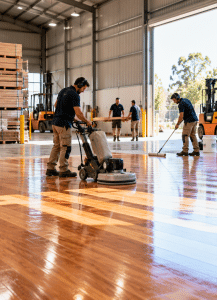
Table of Contents
- Understanding Warehouse Floor Sanding in Australia
- When a Warehouse Floor Should Be Sanded
- Timber Floor Sanding vs Concrete Floor Grinding
- How the Commercial Floor Sanding Process Works
- Why the Correct Sanding Sequence Matters
- Dust Control and Workplace Safety
- Choosing a Finish for a Warehouse Timber Floor
- Slip Resistance and Commercial Floor Safety
- Full Sanding vs Recoating vs Replacement
- Preparing a Warehouse for Floor Sanding
- How to Choose a Floor Sanding Contractor
- Common Warehouse Floor Sanding Mistakes
- Maintaining the Floor After Restoration
- People Also Ask
- Expert Q&A
- Conclusion
Understanding floor+sanding+warehouse+australia Searches
The phrase floor+sanding+warehouse+australia may look unusual because the plus signs often appear in exported keyword data, advertising tools or search URLs. In normal Australian English, people are more likely to type phrases such as:
- warehouse floor sanding Australia
- commercial timber floor sanding
- industrial timber floor restoration
- warehouse timber floor polishing
- commercial floor sanding near me
- timber floor refinishing Australia
- warehouse floor restoration
- commercial sanding and polishing
Although the wording changes, the underlying search intent is similar. A facility owner, manager or contractor usually wants to know whether an existing timber surface can be restored instead of replaced.
That distinction can have a major impact on project planning.
A worn coating does not necessarily mean the timber itself has reached the end of its life. Likewise, scratches, discolouration and surface wear do not automatically justify replacing the entire floor.
According to the Australian Timber Flooring Association, floors intended for sanding and coating should first be assessed for their condition, and that assessment may include moisture considerations. Preparation can include cleaning, filling where appropriate, dust minimisation and protection before sanding begins. Australian Timber Flooring Association sanding and coating guidance
Therefore, inspection should come before assumptions.
When Does a Warehouse Timber Floor Need Sanding?
A warehouse-style timber floor does not need full sanding simply because it has lost some shine.
Full sanding is generally more appropriate when the existing surface has substantial wear that cannot be corrected through routine cleaning or a maintenance recoat.
Common warning signs include:
- deep scratches through the existing finish
- significant coating deterioration
- widespread dull or bare timber areas
- stains that have penetrated the existing surface coating
- uneven wear paths
- previous coating failure
- visible sanding defects from earlier work
- minor surface irregularities that can safely be corrected
- widespread deterioration that makes recoating unsuitable
However, some defects require repairs before sanding.
For example, loose boards, structural movement, moisture-related problems, severe cupping, damaged substrates or significant gaps should not simply be hidden under a new coating.
The floor+sanding+warehouse+australia decision should therefore start with a question: What is actually causing the floor to look or perform poorly?
If the problem is mainly coating wear, a recoat may sometimes be sufficient. If the problem extends into the timber surface, sanding may be appropriate. Meanwhile, if the timber or substrate has serious structural deterioration, repair or replacement may be necessary.
Timber Floor Sanding vs Concrete Floor Grinding
One of the most important issues for warehouse owners is identifying the actual flooring material.
Traditional floor sanding is designed for timber. Concrete warehouses require a different process.
| Factor | Timber Floor Sanding | Concrete Grinding/Polishing |
| Main material | Solid or suitable engineered timber | Concrete slab |
| Main objective | Remove old coating and controlled amounts of timber | Mechanically refine or prepare concrete |
| Typical machines | Belt/drum sanders, edgers and orbital equipment | Diamond grinders and polishers |
| Surface progression | Abrasive grit stages | Diamond tooling stages |
| Final treatment | Timber coating, oil or compatible finish | Concrete densifier, sealer or coating |
| Main risk if overworked | Removing excessive timber | Excessive grinding or uneven aggregate exposure |
| Common locations | Heritage warehouses, halls, retail and converted industrial spaces | Distribution centres and modern industrial warehouses |
Consequently, someone searching floor+sanding+warehouse+australia should confirm whether the floor is timber before requesting traditional sanding.
A flooring professional should also determine whether the timber construction has sufficient sanding allowance remaining. This is particularly important with previously sanded floors and some engineered timber products.
How the floor+sanding+warehouse+australia Process Works
A professional commercial floor restoration project usually involves more than running a sanding machine across the floor.
1. Initial Site Assessment
First, the contractor should inspect the floor.
Important factors include:
- timber type where identifiable
- floor construction
- previous coatings
- surface wear
- stains
- damaged boards
- loose boards
- moisture concerns
- access points
- total floor area
- machinery or fixtures that cannot be moved
- business operating requirements
The purpose of this stage is to identify both the achievable result and potential problems.
2. Operational Planning
A warehouse may operate six or seven days a week. Therefore, downtime often influences the job almost as much as the flooring condition.
The contractor and facility manager may need to establish:
- work zones
- temporary exclusion areas
- staff access routes
- equipment relocation
- drying and curing periods
- delivery schedules
- ventilation requirements
- reopening stages
For large sites, staged restoration may reduce disruption.
However, staging also requires careful planning because adjoining sections need a consistent appearance.
3. Surface Preparation
Before sanding starts, movable objects are removed and the floor is cleaned.
Protruding fasteners must be dealt with appropriately. Repairs may also be required before the full sanding sequence begins.
Dust-sensitive machinery, stock and equipment should be protected or relocated where necessary.
4. Initial Sanding
The first sanding stages remove the existing finish and address appropriate surface imperfections.
The abrasive selected depends on the floor condition.
A badly worn surface may require a more aggressive starting abrasive than a relatively smooth floor. However, starting unnecessarily coarse can remove more timber than required.
5. Progressive Sanding
The floor is then refined through progressively finer abrasives.
Each stage should remove scratch patterns left by the previous abrasive.
This is important because coating does not magically hide deep sanding marks. In fact, some finishes make poor sanding patterns more obvious.
6. Edge and Detail Work
Large sanding machines cannot reach every edge, doorway and corner.
Therefore, separate edging and detail equipment is normally required.
Poor edge blending can result in visible differences between the perimeter and the main floor area.
7. Final Surface Preparation
Before coating, the surface should be clean and appropriately prepared.
Residual sanding dust can interfere with the appearance of a finish.
The contractor should also confirm that conditions suit the chosen coating system.
8. Coating Application
Finally, the specified coating is applied according to the product system.
The appropriate number of coats, drying intervals and reopening time depend on the coating rather than a universal rule.
Therefore, facility managers should obtain product-specific advice before scheduling staff, stock or equipment to return.
Why the Sanding Sequence Matters
For floor+sanding+warehouse+australia projects, abrasive selection is one of the technical details that customers may never see but that strongly affects the final result.
Think of sanding as gradually refining scratches.
A coarse abrasive removes material quickly but creates relatively deep scratch patterns. A medium abrasive removes those scratches. A finer abrasive then prepares the floor for finishing.
Skipping too far between abrasive grades can leave scratches behind.
On the other hand, excessively sanding the surface wastes valuable timber.
This balance explains why professional experience matters.
The Australian Timber Flooring Association notes that sanding should create a flat surface suitable for the specified coating system while supporting an acceptable final appearance.
Therefore, more sanding is not automatically better sanding.
The objective is controlled sanding.
Dust Control and Workplace Safety
Wood dust is not merely a cleaning inconvenience.
It is also a workplace exposure issue.
Safe Work Australia identifies wood dust among potential occupational lung disease hazards and states that workplace risks from airborne contaminants must be eliminated or minimised so far as reasonably practicable.
For that reason, professional warehouse floor sanding should include suitable dust-control measures.
These can include:
- effective extraction connected to sanding equipment
- local dust capture
- appropriate ventilation
- controlled work zones
- housekeeping procedures
- correct handling of collected dust
- suitable PPE based on the risk assessment
- keeping uninvolved workers away from active sanding areas
Safe Work Australia also lists on-tool dust extraction and local exhaust ventilation among methods used to manage dust exposure. Safe Work Australia guidance on dust control
An Important 2026 WHS Update
As of September 2026, Australia is transitioning from Workplace Exposure Standards to Workplace Exposure Limits for airborne contaminants.
Safe Work Australia states that the existing WES framework remains applicable until 30 November 2026, with the WEL list applying from 1 December 2026. Businesses should therefore check the current requirements when planning future work.
These references are general workplace-safety information, not legal advice. Site-specific obligations should be reviewed with the relevant workplace health and safety adviser and state or territory regulator.
Choosing a Finish for Warehouse Timber Floors
Sanding prepares the surface. The coating then becomes the working layer exposed to traffic, cleaning and daily use.
Therefore, coating selection deserves as much attention as sanding.
Factors to discuss include:
Traffic Levels
A warehouse showroom or commercial hall may experience substantially more pedestrian traffic than a bedroom.
Consequently, the chosen system should suit the expected use.
Cleaning Requirements
Consider how often the floor is cleaned and which cleaning products are used.
A coating that performs well but cannot tolerate the site’s normal maintenance routine may create unnecessary problems.
Appearance
Common sheen options include matt, satin and gloss.
However, appearance should not be the only factor.
Higher visual shine does not automatically mean better durability, and the most appropriate finish depends on both the environment and coating system.
Downtime
Commercial operations may need predictable drying and curing windows.
Ask the contractor to distinguish between:
- dry to touch
- light foot traffic
- normal foot traffic
- furniture or equipment replacement
- full curing
These stages are not necessarily the same.
Compatibility
Existing timber, stains, fillers and previous finishes can influence coating selection.
Therefore, avoid choosing a coating purely from an online photograph.
Slip Resistance Matters After floor+sanding+warehouse+australia Work
Warehouse and commercial floors must support safe movement.
That makes slip resistance an important part of the restoration discussion.
Safe Work Australia lists polished, wet or greasy floors among potential slip hazards and advises workplaces to manage floor conditions, contaminants and other risks.
A particularly relevant Australian data point was published on 29 September 2026. Safe Work Australia reported that 32,000 workers’ compensation claims for serious injuries arising from slips, trips and falls were made in 2024–25. That statistic covers Australian workplaces generally and should not be interpreted as warehouse-floor-specific data, but it shows why workplace floor safety deserves attention. Safe Work Australia guide to slips, trips and falls
Facility managers should therefore consider:
- expected contaminants such as water or dust
- pedestrian traffic
- loading areas
- trolley movement
- cleaning practices
- entrances exposed to wet weather
- transitions between flooring materials
- required slip-performance specifications
Do not assume that the glossiest finish is automatically suitable for every warehouse.
Where a specific slip-resistance requirement applies, discuss testing and product specifications with the contractor and relevant project professional.
Full Sanding vs Recoating vs Replacement
People entering floor+sanding+warehouse+australia into Google may assume full sanding is the only restoration option.
It is not.
| Option | Best Suited To | Main Advantage | Key Limitation |
| Maintenance recoat | Existing coating is generally sound but worn | Less invasive than full sanding | Cannot correct deep timber damage |
| Full sand and refinish | Significant coating failure, scratches or surface damage | Restores the timber surface before recoating | Removes some timber and requires more preparation |
| Local repairs plus sanding | Damaged sections within an otherwise restorable floor | Preserves more existing flooring | Colour matching can require care |
| Replacement | Structurally unsuitable or severely damaged flooring | Provides a new flooring system | Greater material, labour and operational impact |
A professional inspection helps determine which approach is justified.
From a practical contractor perspective, preserving an existing timber floor can make sense when the boards remain serviceable. However, repeatedly sanding a floor unnecessarily reduces its remaining sanding allowance.
Therefore, restoration should be based on condition rather than habit.
Warehouse Floor Sanding Preparation Checklist
Before a floor+sanding+warehouse+australia project begins, use the following numbered checklist.
- Identify the flooring material.
Confirm whether the surface is solid timber, engineered timber, parquetry, concrete or another product. - Record visible damage.
Photograph scratches, stains, coating loss, loose boards, gaps and uneven areas. - Identify operational constraints.
Document opening hours, delivery times, shift changes and areas that must remain accessible. - List immovable equipment.
Note machinery, shelving, counters and fixed installations that may affect sanding access. - Plan stock protection.
Remove or protect sensitive products from work zones. - Discuss dust management.
Ask how sanding dust will be captured, contained and removed. - Confirm repair requirements.
Establish whether damaged boards, fixings or other defects need work before sanding. - Choose the coating system.
Base the decision on traffic, maintenance, appearance, safety requirements and downtime. - Confirm access restrictions.
Document when staff, customers, forklifts, trolleys or equipment can safely return. - Arrange final inspection and maintenance guidance.
Ensure the completed floor is reviewed and obtain cleaning and maintenance instructions.
This preparation can reduce misunderstandings once the warehouse has been cleared.
How to Choose a Commercial Floor Sanding Contractor
A large commercial job should not be awarded purely because one quote is cheaper.
Instead, compare the scope behind each price.
Ask potential contractors about:
Commercial Experience
Residential sanding and commercial restoration share many techniques, but large commercial areas introduce scheduling, access and operational challenges.
Ask for relevant project experience.
Inspection Process
Be cautious if a definitive restoration specification is produced without properly examining the floor.
The contractor should understand what is being sanded before promising a result.
Sanding Method
Ask which equipment and abrasive sequence are proposed.
You do not need to become a flooring technician. However, the contractor should be capable of explaining the process clearly.
Dust Control
Ask how dust is captured and how adjacent areas will be protected.
“Dust controlled” is a more realistic concept than assuming any sanding environment will be literally free from every particle.
Coating Specification
Request the exact coating system rather than accepting vague descriptions such as “premium polish”.
The documentation should identify the product and expected application process.
Drying and Reopening Instructions
Ask when different activities can resume.
A floor that tolerates careful foot traffic may still be unsuitable for heavy equipment or other loads.
Insurance and Relevant Licensing
Requirements vary with location, project type and scope.
Confirm the contractor holds any licences, insurance and administrative documentation applicable to the work.
This is a project-administration step rather than legal advice.
Written Scope
The quotation should clearly describe:
- floor area
- repairs included
- sanding scope
- coating system
- number of coats where applicable
- exclusions
- access requirements
- indicative schedule
- responsibilities for moving fixtures or stock
Clear documentation protects both parties from avoidable confusion.
Common floor+sanding+warehouse+australia Mistakes
Mistake 1: Sanding Before Finding the Cause of Damage
If moisture or structural movement caused the problem, refinishing the visible surface alone may not solve it.
Investigate first.
Mistake 2: Assuming Every Warehouse Floor Can Be Sanded
Concrete does not receive conventional timber sanding.
Likewise, some engineered floors have limited wear layers that require careful assessment.
Mistake 3: Using an Abrasive That Is Too Aggressive
Removing excessive timber shortens the useful sanding life of the floor.
The correct starting abrasive depends on the existing surface.
Mistake 4: Ignoring Edges
A central floor area can look excellent while poor edge work remains obvious around walls and doorways.
Edge sanding must blend into the overall surface.
Mistake 5: Choosing a Finish Only for Appearance
Commercial floors must also support cleaning, wear, operational requirements and suitable grip.
Mistake 6: Returning Equipment Too Quickly
Drying and curing are different concepts.
Always follow the specified coating manufacturer’s return-to-service requirements.
Mistake 7: Ignoring Future Maintenance
Even a well-restored timber floor needs ongoing care.
Planning maintenance from the beginning can help avoid unnecessary aggressive restoration later.
Maintaining a Commercial Timber Floor After Sanding
The best time to plan the next maintenance cycle is immediately after the current restoration.
Start with basic controls.
Use suitable entrance matting where appropriate, because tracked grit can behave like abrasive material under shoes and wheels.
Clean spills promptly.
Use cleaning products compatible with the coating.
Avoid flooding timber floors with water.
Inspect high-traffic paths periodically.
Protect the floor during furniture or equipment movement.
Most importantly, do not wait until every part of the coating has worn completely through before asking a flooring professional to inspect the surface.
A maintenance recoat may sometimes restore protection without requiring another full sand.
That is one reason a long-term floor-maintenance strategy can be more economical than treating every deterioration problem as a major restoration project.
People Also Ask About floor+sanding+warehouse+australia
How much does warehouse floor sanding cost in Australia?
There is no reliable Australia-wide fixed price because cost depends on floor area, timber condition, repairs, coating selection, site access and operational scheduling. A site inspection usually produces a more meaningful quotation than a generic square-metre figure.
Can a warehouse stay open while timber floor sanding is happening?
Sometimes work can be divided into controlled stages, but active sanding and coating areas generally require restricted access. Whether other parts of the site can remain operational depends on layout, dust controls, ventilation, coating requirements and workplace risk management.
Is warehouse floor sanding completely dust-free?
No sanding process should be assumed to produce literally zero dust. Modern extraction systems can substantially control dust at its source, but containment, housekeeping and appropriate work-zone controls are still important.
Can concrete warehouse floors be floor sanded?
Not using the normal timber sanding process. Concrete floors are generally mechanically ground, polished or prepared for coatings using equipment designed specifically for concrete.
What is the best finish after commercial timber floor sanding?
There is no single best finish for every site. Traffic volume, cleaning practices, appearance, drying time, slip requirements and coating compatibility should all influence the decision.
Expert Q&A: Warehouse Floor Sanding in Australia
1. How do I know whether an old timber warehouse floor has enough material left to sand?
A contractor should inspect the floor construction and previous sanding history where known. Particular care is required around tongue-and-groove profiles and engineered products because removing too much material can compromise the usable surface.
2. Should damaged timber boards be replaced before or after sanding?
Significant repairs are normally identified and planned before final sanding so repaired areas can be integrated into the finished surface. However, the exact sequence depends on the repair and flooring construction.
3. Can forklift traffic resume immediately after a warehouse floor is coated?
Do not assume that it can. Heavy rolling loads can impose very different demands from light pedestrian traffic, so return-to-service timing should come directly from the specified coating system and flooring contractor.
4. Can court lines, safety markings or directional markings be added to a timber floor?
Some commercial timber flooring systems can incorporate line marking, but compatibility between coatings, line-marking materials and the intended use must be confirmed. The sequence should be planned before the final coating specification is approved.
5. How often should a warehouse timber floor be resanded?
There is no universal timetable. Usage, timber type, coating, cleaning, grit exposure, wheeled traffic and maintenance all affect wear. Periodic inspection is better than automatically scheduling aggressive sanding every fixed number of years.
Planning a Successful Warehouse Timber Floor Restoration
A successful floor+sanding+warehouse+australia project begins long before the sanding machine is switched on.
First, determine what flooring system is actually present.
Then inspect its condition and identify the causes of deterioration.
Next, decide whether the appropriate treatment is cleaning, recoating, repair, full sanding or replacement.
After that, plan dust control, operational access, coating requirements and safe return to service.
Finally, create a maintenance strategy so the restored surface can be protected rather than simply forgotten.
This process matters because a commercial timber floor is not only a visual feature.
It is also part of the working environment.
People walk across it. Trolleys may travel over it. Products and equipment may be moved across it. Cleaning chemicals interact with it. Dirt and moisture reach it from entrances.
Therefore, the restoration specification should reflect how the site actually operates.
The search term floor+sanding+warehouse+australia may be simple, but the best solution rarely comes from a one-size-fits-all package.
It comes from assessing the timber, understanding the building and selecting the least aggressive process that can achieve the required result.
Conclusion
For anyone researching floor+sanding+warehouse+australia, the key lesson is to treat warehouse timber restoration as a complete system rather than simply a sanding job.
The floor should first be inspected. Repairs and operational constraints should then be identified. Sanding should remove only what is necessary, while progressive abrasives prepare the surface for a compatible coating. Dust controls, workplace access, slip considerations and curing periods should also form part of the plan.
Most importantly, confirm whether full sanding is actually necessary. A suitable recoat may sometimes preserve a floor with less intervention, while serious structural or moisture problems may require repair before refinishing can begin.
For a professional assessment of an existing timber floor and guidance on sanding, polishing, recoating or commercial floor restoration, speak with Enviro Floors timber floor specialists and provide details about your floor area, condition and intended use.