post
Floor Sanding Near Me: A Complete Australian Guide

When homeowners search for floor sanding near me, they are usually looking for a local professional who can restore tired timber floors without unnecessary replacement. The challenge is knowing which services are suitable, what the sanding process involves, what affects the price and how to compare local flooring contractors fairly.
Timber floors are a popular choice across Australia because they can be durable, repairable and relatively straightforward to maintain when properly finished. However, sanding is a skilled restoration process. The condition of the boards, previous sanding, existing coatings, floor construction and required finish all affect the work involved.
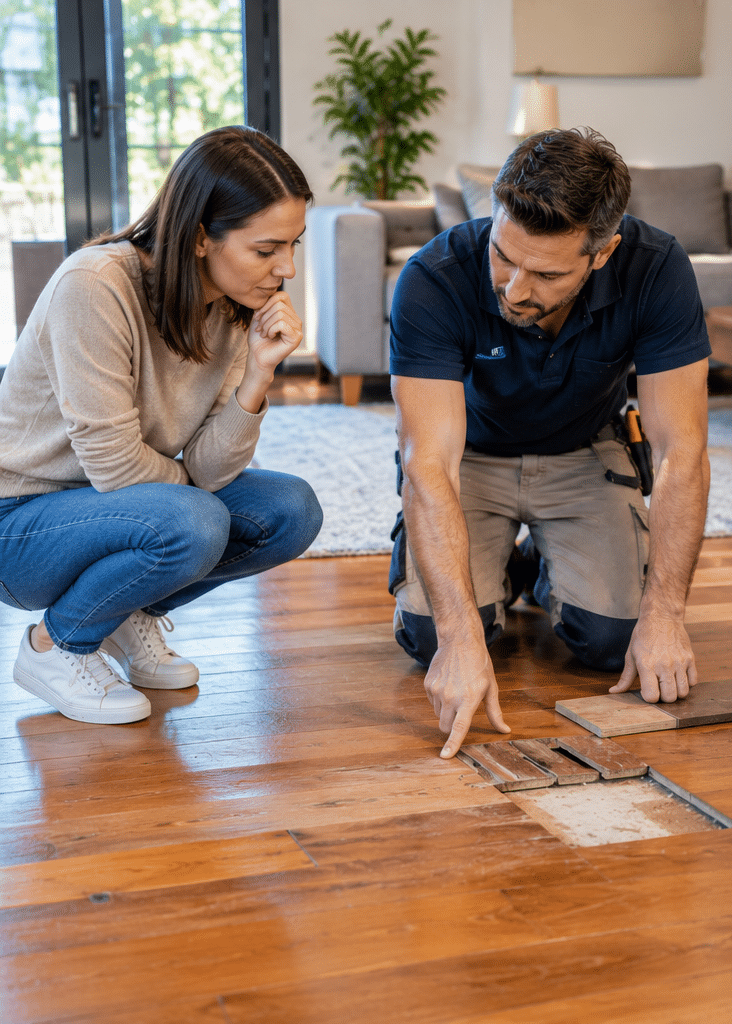
From my experience with timber-floor restoration projects, the most useful starting point is not simply finding the closest contractor. Instead, it is finding a provider who can inspect the floor, explain the proposed process and give you a realistic idea of what can and cannot be achieved.
Floor sanding near me refers to local professional services that mechanically remove worn coatings and surface imperfections from suitable timber floors. The floor is progressively sanded, prepared, cleaned and refinished to improve its appearance and protect the timber for continued everyday use.

Table of Contents
- What Does Floor Sanding Near Me Actually Mean?
- Why Australian Homeowners Choose Local Floor Sanding
- Which Floors Can Be Sanded?
- The Floor Sanding Near Me Process
- Why Professional Floor Sanding Requires Skill
- How Much Does Floor Sanding Cost?
- What Changes a Floor Sanding Quote?
- Floor Sanding Near Me: How to Compare Local Contractors
- Preparing Your Australian Home
- Dust Control and Australian Workplace Safety
- Floor Sanding vs Recoating
- Choosing a Timber Floor Finish
- DIY or Professional Floor Sanding Near Me?
- Comparison Table: Local Flooring Options
- Floor Sanding Near Me Checklist
- Maintenance After Floor Sanding
- Common Problems Professional Sanding Can Address
- People Also Ask
- Expert Q&A
- Conclusion
What Does Floor Sanding Near Me Actually Mean?
The phrase “near me” is a local search term. It tells Google that the searcher wants a service available in their geographical area rather than a general article about timber floors.
However, proximity should only be the beginning of the selection process.
A suitable local floor sanding contractor should be able to assess the actual floor and explain:
- What type of timber is present.
- Whether the floor is suitable for sanding.
- How much preparation is required.
- Whether repairs are necessary.
- Which sanding sequence is appropriate.
- What finish will be applied.
- How dust will be controlled.
- How long the project should take.
- When the floor can be used again.
- How it should be maintained afterwards.
Why the floor assessment matters
Timber flooring is not a single product.
Australian homes can contain:
- Solid timber boards.
- Structural timber flooring.
- Parquetry.
- Engineered timber.
- Floating timber flooring.
- Older recycled timber.
- Timber floors with previous coatings.
These products can respond differently to sanding.
For example, solid timber may have considerable material available for restoration. An engineered board, however, has a timber wear layer over another material. The thickness and construction of that wear layer can determine whether sanding is appropriate.
CHOICE describes several timber flooring types, including structural solid boards, parquetry and floating floors, and notes that some floating floors can be refurbished depending on their construction. (CHOICE)
Therefore, a professional should identify the flooring before recommending a treatment.
Why Australian Homeowners Choose Local Floor Sanding
There are several reasons someone searches for floor sanding near me rather than simply searching for timber flooring.
Restore instead of replace
A tired timber floor may still have plenty of useful life.
If the underlying boards remain sound, sanding and refinishing can restore the surface without removing the entire floor.
That can be particularly relevant in older Australian homes where original timber flooring is part of the property’s character.
Improve worn areas
Everyday foot traffic gradually affects a timber floor.
Common signs include:
- Dull patches.
- Scratches.
- Scuff marks.
- Uneven sheen.
- Worn coating.
- Minor dents.
- Surface discolouration.
Sanding can address suitable surface damage by removing a controlled amount of material and creating a fresh surface for finishing.
However, deep damage is different.
If a board is badly split, rotten or structurally compromised, sanding is not a substitute for repair.
Refresh the overall appearance
Timber can change visually as it ages.
Sun exposure, previous finishes, furniture placement and normal wear can all contribute to variation.
A professionally restored surface can create a more consistent appearance.
Yet, natural timber variation should remain part of the expected result. Grain, knots, colour and board-to-board differences are characteristics of real wood.
Which Floors Can Be Sanded?
One of the most important parts of finding floor sanding near me is confirming that your particular flooring is suitable.
Solid timber
Solid timber flooring is commonly suitable for sanding and refinishing.
Because the boards consist predominantly of timber, they may be capable of multiple restoration cycles.
However, there is no universal number of times a floor can be sanded.
Previous sanding depth, board thickness and existing condition all matter.
Parquetry
Parquetry consists of smaller timber pieces arranged into patterns.
It can often be restored, but sanding requires careful control.
The direction of the grain changes across the pattern, and aggressive sanding can affect the appearance of individual blocks.
Engineered timber
Engineered timber has a real timber surface bonded to a different substrate.
Some products can be sanded and refinished.
Others may have a relatively thin wear layer.
Therefore, the product’s construction should be confirmed before work begins.
Floating timber flooring
Some floating floors can be refurbished, but suitability depends on the product.
Do not assume that every floating floor can tolerate conventional sanding.
Laminate flooring
Laminate is different from timber.
Its decorative layer is generally not designed to be sanded like a solid timber board.
Attempting to sand a laminate surface can damage the decorative layer.
The Floor Sanding Near Me Process
A professional project usually follows several stages.
The exact sequence can change according to the floor’s condition.
1. Initial inspection
The contractor assesses the floor before deciding how aggressively it should be treated.
They may look for:
- Loose boards.
- Nails or fixings.
- Previous repairs.
- Deep scratches.
- Stains.
- Gaps.
- Existing coating.
- Board thickness.
- Signs of moisture.
- Areas of movement.
This stage is important because sanding is irreversible.
Once timber has been removed, it cannot simply be put back.
2. Preparation
The room is prepared for machinery and finishing products.
Furniture generally needs to be removed from the work area, unless the contractor has specifically agreed to move it.
The floor may also require preparation around edges, doorways and damaged boards.
3. Coarse sanding
The initial sanding removes old coating and levels appropriate surface imperfections.
The abrasive grade depends on the existing surface.
Too little preparation can leave old coating behind.
Too much can remove unnecessary timber.
The operator therefore needs to balance effectiveness with conservation of the existing floor.
4. Intermediate sanding
Progressively finer abrasives are used.
Each stage reduces the marks left by the previous stage.
The aim is to create an increasingly consistent surface before finishing.
5. Edge sanding
Large floor sanding machines cannot reach every part of a room.
Specialised equipment is therefore used around walls and other areas.
Edge work matters because differences between the centre and perimeter can remain visible after finishing.
6. Detail work
Corners, thresholds and difficult areas may need additional preparation.
The exact work depends on room layout.
7. Repairs
Some floors require board repairs or other remedial work.
For example, severely damaged boards may need to be replaced rather than repeatedly sanded.
8. Final cleaning
Dust and debris need to be removed before the coating system is applied.
Residual dust can affect the finish.
9. First coating stage
The selected coating is applied according to the manufacturer’s instructions.
The product and application system should be appropriate for the timber and intended use.
10. Further preparation and coats
Some systems require intermediate preparation before additional coats.
The number and type of coating stages depend on the product.
11. Drying and curing
The surface may become touch-dry before the coating has fully cured.
Therefore, homeowners should follow the contractor’s instructions regarding:
- Walking on the floor.
- Replacing furniture.
- Placing rugs.
- Cleaning.
- Normal household use.
Why Professional Floor Sanding Requires Skill
Floor sanding machines remove timber quickly.
That is both their strength and their risk.
An inexperienced operator can create:
- Uneven sanding.
- Machine marks.
- Low spots.
- Over-sanded areas.
- Damaged edges.
- Uneven transitions.
- Visible scratches beneath the final coating.
These problems can be difficult to correct.
Sanding is progressive
Professional sanding is not normally a single pass.
The abrasive sequence becomes finer as the work progresses.
This matters because coarse abrasives remove material efficiently but leave more prominent scratches.
Fine abrasives refine the surface but are not intended to perform the same heavy removal work.
Using the correct sequence helps produce a consistent surface.
Direction matters
Timber has grain direction.
Sanding technique needs to account for the floor construction and equipment being used.
Parquetry presents an additional challenge because the grain changes between blocks.
Edges require separate equipment
The main sanding machine cannot reach directly against walls.
Edge sanding must therefore be integrated into the process rather than treated as an afterthought.
How Much Does Floor Sanding Cost?
Searchers often want a simple answer to this question.
In reality, there is no single Australian price that applies to every project.
Published prices should be treated as estimates unless they are based on your specific floor.
Why pricing varies
The final quotation can depend on:
- Floor size.
- Timber type.
- Floor condition.
- Existing coating.
- Number of sanding stages.
- Repairs.
- Room layout.
- Access.
- Furniture.
- Selected finish.
- Number of coats.
- Cleaning requirements.
- Location.
For example, a large open room with relatively sound flooring can be more straightforward than a smaller property with heavily worn boards, multiple rooms and extensive repairs.
Price per square metre is only one factor
A square-metre rate can help with initial budgeting.
However, it does not tell you what work is included.
One quotation might cover only sanding.
Another could include sanding, edging, gap treatment, coating and multiple finishing stages.
Comparing the numbers without comparing the scope can produce a misleading result.
What Changes a Floor Sanding Quote?
1. Existing floor condition
A heavily worn floor may need more preparation.
2. Previous coatings
Old finishes can affect how much preparation is required.
3. Repairs
Damaged boards, loose boards and other defects can add labour.
4. Floor type
Solid timber, parquetry and engineered flooring can require different approaches.
5. Access
Stairs, narrow entrances and restricted access can make equipment movement more difficult.
6. Furniture
Some contractors require completely empty rooms. Others may offer furniture-moving services.
Always confirm this beforehand.
7. Finish
Different finishes have different application requirements and product costs.
8. Project size
Large projects can involve more material and labour but may also benefit from more efficient setup.
9. Additional preparation
Filling, repairs, staining or other treatments can change the scope.
10. Location
Travel and local operating costs can vary between Australian regions.
For these reasons, a written quotation is preferable to relying on a generic online figure.
Floor Sanding Near Me: How to Compare Local Contractors
When you search floor sanding near me, Google may show many providers.
Do not select a contractor based solely on proximity.
Instead, compare the service itself.
Ask what is included
A useful quotation should explain:
- Sanding.
- Edge sanding.
- Preparation.
- Repairs.
- Coatings.
- Number of coats.
- Cleaning.
- Dust control.
- Furniture handling.
- Additional work.
Ask what is excluded
Exclusions are just as important.
For example, a quotation may not include:
- Board replacement.
- Staining.
- Furniture removal.
- Additional repairs.
- Subfloor work.
Knowing this before the project starts can reduce misunderstandings.
Ask how the floor will be assessed
A contractor should be interested in the actual floor.
Be cautious of recommendations made without knowing the flooring type and condition.
Ask about the finish
Do not simply ask for “the best finish”.
Explain how the room is used.
A busy family home has different demands from a formal room that receives little traffic.
Preparing Your Australian Home
Good preparation can reduce disruption.
Move furniture
Clear the work area according to the contractor’s instructions.
If furniture movement is included, confirm exactly what the service covers.
Remove fragile objects
Floor sanding involves machinery and movement.
Remove delicate objects from nearby areas where practical.
Plan access
Make sure the contractor can bring equipment into the property.
This can matter particularly in apartments and properties with stairs or restricted parking.
Plan for pets
Keep pets away from the work area.
Equipment, dust, noise and wet coatings can create hazards.
Plan your routine
Depending on the project, you may temporarily lose access to one or more rooms.
Plan meals, sleeping arrangements and household movement accordingly.
Consider neighbouring areas
Where practical, discuss dust containment and protection of adjoining surfaces with the contractor.
Floor Sanding Near Me and Australian Climate
Australia is geographically diverse.
Brisbane, Sydney, Melbourne, Perth, Adelaide and other locations have different environmental conditions.
Timber responds to moisture and temperature.
That means environmental conditions can influence:
- Board movement.
- Gaps.
- Coating application.
- Drying.
- Curing.
- Long-term maintenance.
Brisbane and humid conditions
In Brisbane and other humid areas, moisture management deserves particular attention.
A floor that shows unusual movement, swelling or persistent moisture damage should be investigated before sanding.
Older Australian homes
Older homes may have floors with years of accumulated wear.
They can also contain previous repairs, old coatings and boards of varying condition.
That makes an initial inspection particularly valuable.
Dust Control and Australian Workplace Safety
Dust is one of the most important practical issues to discuss when arranging floor sanding near me.
Sanding timber creates wood dust.
Safe Work Australia identifies wood dust generated during activities such as cutting, sanding and machining timber as an occupational hazard. (Safe Work Australia)
This means dust extraction should not be treated merely as a cleanliness feature.
It is part of workplace risk management.
What good dust control can involve
Depending on the equipment and work environment, controls can include:
- On-tool extraction.
- Suitable vacuum systems.
- Effective filtration.
- Appropriate ventilation.
- Work-area management.
- Regular equipment maintenance.
- Suitable respiratory protection where required.
- Proper housekeeping.
Safe Work Australia’s guidance identifies local exhaust ventilation, water suppression and on-tool dust extraction among controls that can help manage hazardous airborne contaminants in construction activities. (Safe Work Australia)
Current Australian exposure requirements
Safe Work Australia is transitioning from the existing Workplace Exposure Standards to a Workplace Exposure Limits framework. As of September 2026, the organisation states that the existing WES requirements continue until 30 November 2026, with the WEL list applying from 1 December 2026. (Safe Work Australia)
Because WHS regulation and enforcement involve Australian jurisdictions, businesses should check the requirements applicable in their state or territory.
This information is general safety information, not legal advice.
What homeowners should ask
A homeowner does not need to manage a contractor’s WHS system personally.
However, it is reasonable to ask:
“What dust-extraction system will you use during sanding?”
A clear answer is preferable to a vague promise that the process will be “dust free”.
No sanding process should be described as producing absolutely no dust.
Floor Sanding vs Recoating
These terms describe different levels of intervention.
Floor sanding
Sanding removes material.
It can address worn coating and suitable surface defects.
Recoating
Recoating generally involves preparing an existing coating and applying another compatible coating without carrying out a full sanding process.
This can be appropriate when the existing surface is still fundamentally sound.
Which one is right?
That depends on the floor.
CHOICE notes that high-traffic timber floors may require buffing and recoating periodically, while major scratches may require sanding and recoating. (CHOICE)
This distinction can save homeowners unnecessary work.
If the coating is sound and the floor only shows light wear, full sanding may not be required.
If the coating has failed or the timber itself is significantly damaged, a more extensive restoration may be appropriate.
Choosing a Timber Floor Finish
The finish affects appearance and maintenance.
Matt finish
A matt finish has relatively low reflectivity.
It can create a subtle, natural appearance.
Satin finish
Satin offers moderate sheen.
It is often selected by homeowners who want some reflection without a strongly glossy appearance.
Gloss finish
Gloss is highly reflective.
It can create a polished appearance but may make dust, scratches and surface imperfections more visible.
Clear versus tinted finishes
A clear finish generally allows the natural timber character to remain prominent.
Tinting or staining can change the colour.
However, staining can produce different results on different timber species.
Always discuss the intended appearance before application.
DIY or Professional Floor Sanding Near Me?
DIY sanding can appear attractive because equipment can sometimes be hired.
However, professional floor sanding requires more than operating a machine.
Possible DIY advantages
- Lower direct labour cost.
- Flexible timing.
- Hands-on control.
- Suitable for experienced DIY renovators.
Potential disadvantages
- Equipment learning curve.
- Risk of uneven sanding.
- Risk of removing excessive timber.
- More responsibility for dust management.
- Additional time.
- Potentially expensive correction work.
The risks are particularly relevant to valuable, old or difficult flooring.
When professional sanding is sensible
Professional treatment is worth considering where:
- The floor is valuable.
- The floor is old.
- The boards have already been sanded.
- The property contains parquetry.
- Several rooms are involved.
- Repairs are required.
- A consistent finish is important.
- You do not have experience with floor sanding equipment.
Comparison Table: Local Flooring Options
| Option | Suitable situation | Main benefit | Main limitation |
| Full sanding and refinishing | Worn coating and significant surface damage | Comprehensive restoration | More intensive |
| Light sanding/buffing and recoating | Sound floor with lighter wear | Less material removal | Not suitable for deep damage |
| Board repair and local treatment | Isolated damage | Addresses specific defects | May not resolve widespread wear |
| Floor replacement | Severely damaged or unsuitable flooring | New flooring system | More invasive and costly |
| DIY sanding | Experienced homeowner with suitable floor | Potential labour savings | Higher risk of mistakes |
The appropriate option depends on the floor’s actual condition.
A professional assessment should identify the least aggressive treatment that can reasonably achieve the desired result.
Floor Sanding Near Me Checklist
Before booking a local contractor, work through this checklist:
- Identify the floor type.
Confirm whether it is solid timber, engineered timber, parquetry or another product. - Inspect the condition.
Look for scratches, stains, gaps, loose boards and worn coating. - Ask whether sanding is appropriate.
Do not assume every timber-look floor can be sanded. - Ask what preparation is required.
Find out whether repairs or additional treatments are necessary. - Discuss the sanding sequence.
Ask how coarse and fine sanding stages will be handled. - Ask about edge work.
Confirm that edges and difficult areas are included. - Discuss dust extraction.
Ask which controls will be used during sanding. - Choose your finish.
Decide whether you prefer matt, satin or gloss. - Request a written quotation.
Compare the scope rather than only the price. - Check exclusions.
Understand what could cost extra. - Plan furniture removal.
Confirm who is responsible for moving furniture. - Plan household access.
Ask when rooms can be used again. - Ask about curing.
Confirm when furniture and rugs can safely return. - Get maintenance instructions.
Find out which products and methods are recommended. - Keep the coating information.
This can help with future maintenance. - Inspect the completed floor.
Review it in appropriate lighting before normal use.
Maintenance After Floor Sanding
A newly refinished floor still needs care.
Remove grit
Grit carried indoors can act as an abrasive.
Regular vacuuming or appropriate dry cleaning can help reduce this.
Clean according to the finish
Do not use a generic cleaning product without checking its compatibility.
Different coatings have different requirements.
Wipe spills promptly
Timber and excessive moisture are not a good combination.
Deal with spills promptly rather than allowing liquid to sit on the surface.
Protect furniture
Felt pads under suitable furniture legs can reduce scratching.
Avoid dragging furniture across the floor.
Use entrance mats
Mats can help capture grit before it reaches the timber.
However, choose mats that are suitable for the particular flooring finish.
Follow early-use instructions
The first days after finishing can be important.
Follow the contractor’s instructions regarding:
- Foot traffic.
- Furniture.
- Rugs.
- Cleaning.
- Heavy objects.
Common Problems Professional Sanding Can Address
Scratches
Surface scratches can often be removed or reduced.
Deep scratches may extend too far into the timber and require additional treatment.
Dull coating
A worn finish can make a timber floor look tired.
Preparation and recoating can restore a more consistent appearance where appropriate.
Uneven sheen
Heavy traffic can create areas that look different from less-used parts of the floor.
Refinishing can sometimes restore consistency.
Minor dents
Some dents can be reduced through sanding.
However, deep compression of timber may remain visible.
Old coating
Multiple layers of old finish can sometimes be removed during restoration.
The appropriate approach depends on what coatings are present.
Staining
Sanding can reduce some stains.
However, stains that have penetrated deeply may remain partly visible.
A contractor should explain this before work begins rather than promising complete removal.
What a Good Local Floor Sanding Quote Should Tell You
A good quotation should be understandable to someone who is not a flooring specialist.
Ideally, it should identify:
Area
Which rooms and approximate floor area are included?
Preparation
What preparation is included?
Repairs
Are damaged boards or other repairs included?
Sanding
What level of sanding is proposed?
Finishing
Which product and sheen are proposed?
Coating
How many application stages are included?
Dust management
What equipment or controls will be used?
Cleaning
Who is responsible for final cleaning?
Furniture
Who moves and replaces furniture?
Timing
How long is the project expected to take?
Aftercare
What are the cleaning and curing requirements?
If a quotation leaves all of these questions unanswered, ask for clarification before committing.
People Also Ask
How do I find the best floor sanding near me?
Start by finding local providers that work with your specific type of timber flooring. Then compare their inspection process, scope of work, dust-control approach, finish options, written quotation and aftercare instructions rather than choosing purely on proximity or headline price.
How long does floor sanding take?
The timeframe varies with floor size, condition, repairs, access and coating requirements. A straightforward residential project can be significantly quicker than a heavily worn floor requiring extensive preparation and multiple finishing stages.
Is floor sanding messy?
Sanding generates dust, although professional extraction equipment can substantially reduce the amount released into the surrounding area. It is better to ask a contractor about their specific dust-control equipment than to rely on claims that a process is completely dust-free.
Can floor sanding remove all scratches?
No. Many surface scratches can be removed or reduced, but deeper damage may extend below the practical sanding depth. In those situations, repair or board replacement may be necessary.
Is it worth sanding old timber floors?
It can be, provided the underlying floor is suitable for restoration. Older timber can have considerable character, but its thickness, previous sanding, damage and moisture condition should be assessed first.
Expert Q&A
1. How do I know whether my timber floor has enough material left to sand?
There is no single visual test that works for every floor.
A flooring professional should inspect the boards, their construction, previous sanding and exposed features such as tongue-and-groove joints where relevant.
If substantial timber has already been removed during earlier renovations, another aggressive sanding process may not be appropriate.
2. Can sanding fix gaps between timber boards?
Sometimes, but sanding does not necessarily solve the reason gaps exist.
Timber naturally responds to changes in moisture and environmental conditions. Small seasonal gaps can therefore be different from gaps caused by damaged boards, installation problems or other conditions.
The cause should be assessed before deciding whether gap filling is appropriate.
3. Should I choose a water-based or solvent-based floor finish?
The answer depends on the timber, desired appearance, application conditions and product system.
Water-based products can provide a relatively clear appearance, while some solvent-based systems can create a warmer visual character. Product formulation and performance vary, so ask the contractor to explain the specific product being proposed rather than comparing categories alone.
4. Can engineered timber be sanded more than once?
It depends primarily on the thickness and construction of the timber wear layer.
Some engineered floors are designed for refurbishment, while others have limited material available above the core.
Before sanding, identify the product and, where possible, check the manufacturer’s specifications.
5. What should I do if a contractor says my floor needs full sanding when I expected a simple polish?
Ask the contractor to explain the difference between the existing coating condition and the timber condition.
If the coating is still sound and only lightly worn, a maintenance treatment may potentially be sufficient. If the coating has failed or the timber itself has significant surface damage, more extensive sanding may be justified.
A useful contractor should be able to explain why the proposed level of intervention is necessary.
Finding Floor Sanding Near Me in Australia
Local search results can be useful, but location alone should not determine your choice.
When comparing a nearby flooring provider, look for evidence that they understand the type of floor you have.
A strong initial conversation should cover:
- Floor type.
- Current condition.
- Previous treatments.
- Desired appearance.
- Sanding requirements.
- Repairs.
- Finish.
- Dust control.
- Project timeframe.
- Aftercare.
This approach helps you compare like with like.
It also reduces the risk of choosing a contractor simply because they advertise a low starting price.
When Floor Sanding May Not Be the Right Answer
Professional advice should sometimes conclude that sanding is not appropriate.
For example, replacement may be more suitable when:
- Boards are structurally unsound.
- Moisture damage is severe.
- The wear layer is insufficient.
- The flooring is laminate.
- Previous sanding has left too little timber.
- The floor has extensive movement.
- The underlying problem has not been resolved.
Likewise, if the floor only has minor wear and a sound coating, full sanding may be unnecessary.
The best restoration plan is not always the most extensive one.
Why Maintenance Matters After Restoration
Floor restoration creates a renewed surface, but everyday use gradually starts the wear process again.
Shoes carry grit.
Furniture moves.
Sunlight affects some finishes.
Spills happen.
High-traffic pathways receive more wear than quiet rooms.
Consequently, maintenance should be considered when choosing the finish.
A household with children, pets and frequent entertaining may need a different maintenance routine from a low-traffic apartment.
CHOICE notes that properly sealed timber flooring can resist spills, stains and chemicals better than unsealed timber, while high-traffic areas still require ongoing maintenance. (CHOICE)
Conclusion
Searching for floor sanding near me is a useful starting point when your timber floors need attention, but the closest contractor is not automatically the right contractor. The quality of the result depends on the floor assessment, sanding technique, preparation, dust management, coating system and aftercare.
Before booking, identify your flooring type and ask whether sanding is genuinely appropriate. Then compare written quotations based on the complete scope of work rather than a headline square-metre price.
Remember, too, that not every worn floor requires complete sanding. A suitable maintenance treatment may be enough for a sound floor with a worn coating, while deep damage may require more substantial restoration.
For professional advice about restoring your existing timber floors, explore Enviro Floors’ timber floor sanding and restoration services.