post
Floor Sanders Near Me: The Complete Australian Guide
When Australians search for floor sanders near me, they are usually looking for more than someone with a sanding machine. They want a flooring professional who can assess the timber, remove worn coatings, manage dust, repair suitable surface defects and leave the floor ready for a durable new finish. From my experience, the biggest difference between a straightforward restoration and an expensive problem often comes down to choosing the right sanding approach before the machine even starts.
This guide explains what local floor sanding services actually do, which timber floors can be sanded, how the process works, what affects pricing, what to ask before booking and how Australian homeowners can prepare their property.
The goal is simple: help you make an informed decision rather than choosing a contractor solely because they appear near the top of a local search result.
What Are Floor Sanders Near Me?
Floor sanders near me are local flooring professionals who use specialised sanding equipment to remove old coatings, surface wear and imperfections from suitable timber floors before refinishing. A professional service may also assess boards, perform minor preparation and apply a protective finish suited to the floor and household.
Table of Contents
- What Do Floor Sanders Near Me Actually Do?
- Why Australians Search for Local Floor Sanders
- Which Timber Floors Can Be Sanded?
- The Floor Sanding Process Explained
- Floor Sanders Near Me: Why Equipment Matters
- What Does Floor Sanding Cost in Australia?
- What Changes a Floor Sanding Quote?
- How to Compare Floor Sanders Near Me
- Preparing Your Home for Floor Sanding
- Dust Control and Safety in Australia
- Floor Sanding, Buffing or Recoating?
- Choosing a Timber Floor Finish
- How Long Does Floor Sanding Take?
- DIY Floor Sanding vs Professional Service
- Comparison Table: Choosing the Right Approach
- Floor Sanders Near Me Checklist
- Maintaining Your Newly Sanded Floor
- Common Problems Sanding Can Address
- People Also Ask
- Expert Q&A
- Final Thoughts
What Do Floor Sanders Near Me Actually Do?
A floor sander is not simply someone who operates a large sanding machine.
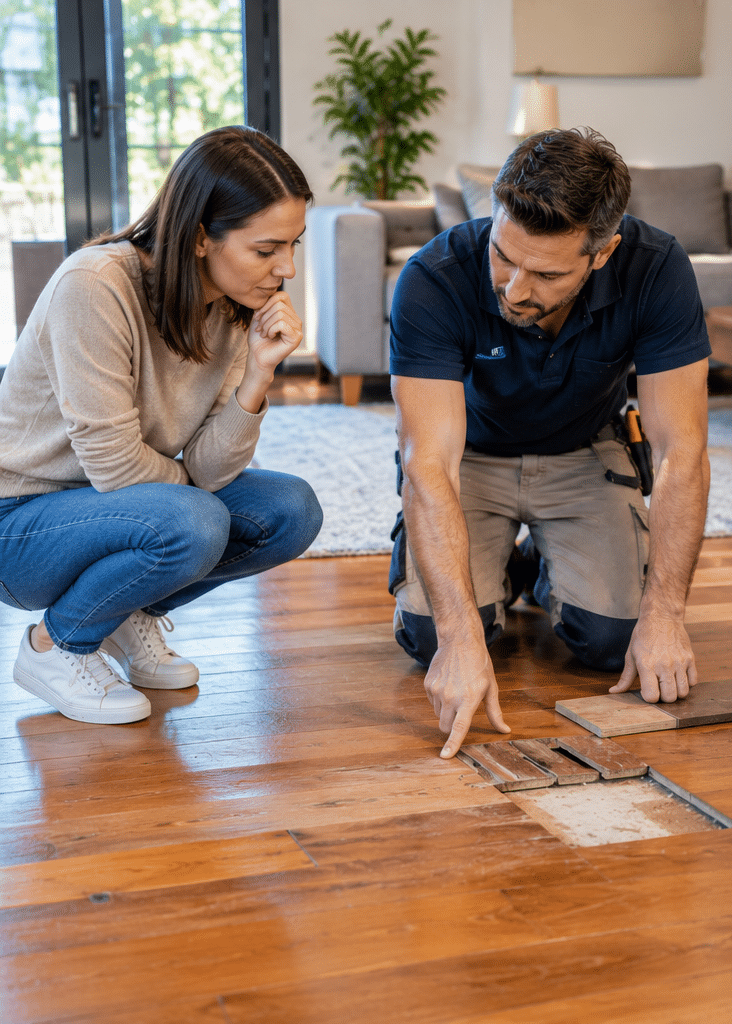
Timber floor restoration involves several stages. First, the existing floor needs to be assessed. The condition of the boards, previous coatings, scratches, dents, gaps, stains and repairs can all influence the work required.
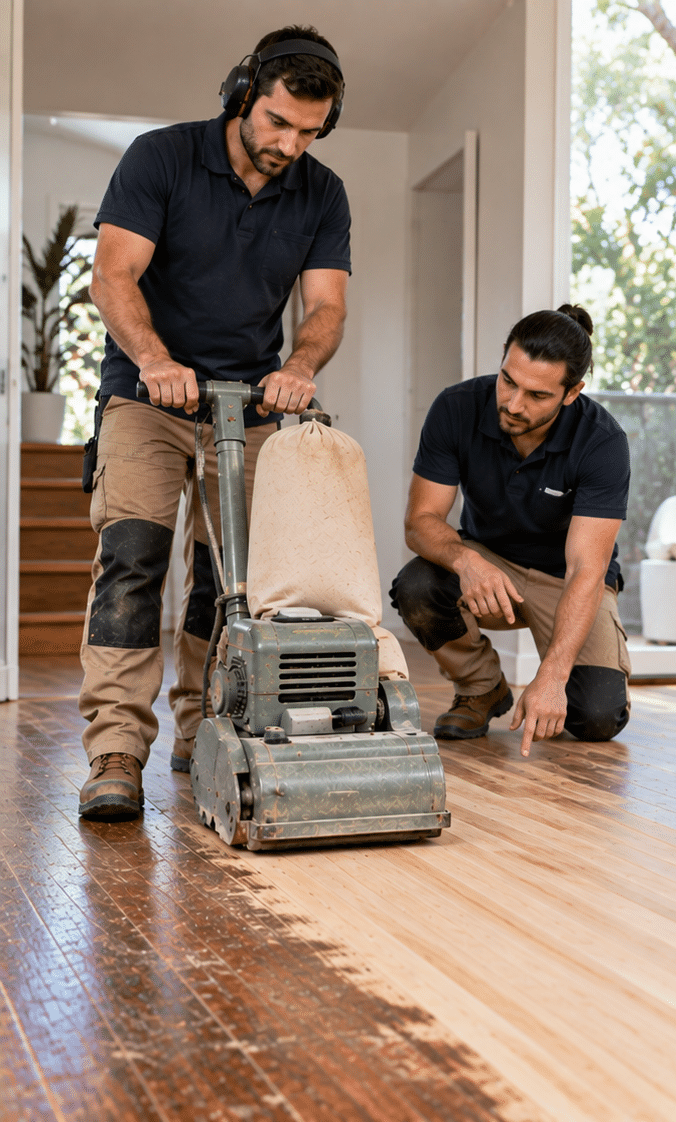
The sanding stage then removes a controlled amount of material from the surface. Coarser abrasives are generally used for removing old finishes and levelling the surface, followed by progressively finer abrasives to improve the appearance and prepare the timber for coating.
After sanding, the floor may be vacuumed and prepared for its selected finish.
Depending on the project, the service may also include:
- Removing old coatings.
- Sanding timber boards.
- Sanding parquetry.
- Edge sanding around skirting boards and corners.
- Filling appropriate gaps or minor defects.
- Replacing damaged boards where required.
- Stain or colour preparation.
- Applying protective coatings.
- Final inspection and clean-up.
However, not every timber floor requires the same treatment.
For example, a floor with light wear may only need a maintenance coat or buffing rather than aggressive sanding. Conversely, a floor with deep scratches, multiple old coatings or significant surface damage may require more extensive preparation.
That distinction is important when comparing floor sanders near me because two contractors may recommend different processes for the same room.
Why Australians Search for Local Floor Sanders
The phrase “near me” reflects a practical concern.
Floor sanding is a physical, site-based service. The contractor needs to visit the property, inspect the floor and bring equipment to the home or commercial premises. Therefore, local availability can matter.
However, proximity should not be the only selection factor.
A contractor located slightly farther away may still be a better fit if they have appropriate experience with the timber species, floor construction and finish you have.
Australian homes also vary considerably.
A Queenslander with traditional timber boards presents different considerations from a contemporary apartment with engineered flooring. Similarly, an older Victorian-era property may have floors with previous repairs, nails, stains or several layers of coating.
So, when searching for floor sanders near me, think of “near me” as the beginning of the selection process rather than the final criterion.
Which Timber Floors Can Be Sanded?
Many solid timber floors can be sanded and refinished several times during their service life. However, the suitability of sanding depends on the construction and remaining timber thickness.
Common examples include:
Solid timber floorboards
Traditional solid boards can often be sanded when sufficient timber remains above the tongue-and-groove structure.
This is one reason older timber floors can sometimes be restored rather than replaced.
Parquetry
Parquetry consists of smaller timber pieces arranged in geometric patterns.
It can be sanded, but the direction of the timber changes across the pattern. As a result, experienced preparation and careful equipment handling are particularly important.
Engineered timber
Engineered timber contains a real timber wear layer over a different structural material.
Some engineered products can be sanded and refinished. Others have a relatively thin wear layer and may not be suitable for conventional sanding.
Therefore, do not assume that every engineered timber floor can be treated like solid hardwood.
Floating timber floors
Some floating timber products can be refurbished, but the manufacturer’s specifications should be checked first.
Laminate flooring
Laminate is different from real timber flooring. Its decorative surface is not a solid timber wear layer, so conventional timber-floor sanding is generally inappropriate.
If you are unsure what you have, ask a professional to identify the flooring construction before sanding begins.
CHOICE notes that Australian timber flooring includes solid structural boards, parquetry and floating flooring, while also pointing out that some floating timber floors can be sanded and refurbished. (CHOICE’s timber and tile flooring guide)
The Floor Sanding Process Explained
A professional floor sanding project generally follows a logical sequence.
1. Initial inspection
The contractor assesses:
- Timber type.
- Floor construction.
- Existing coating.
- Surface damage.
- Board condition.
- Previous repairs.
- Moisture-related concerns.
- Access to the property.
- Furniture and room layout.
This inspection helps determine whether sanding is appropriate.
2. Preparation
Furniture is removed from the working area where possible.
The contractor may also identify protruding nails or other hazards that could interfere with sanding equipment.
Preparation is important because sanding machines operate at high speed. Unexpected objects can damage equipment or affect the floor.
3. Coarse sanding
The first sanding stage is designed to remove old coatings and significant surface irregularities.
The objective is controlled material removal, not simply making the timber look lighter.
4. Intermediate sanding
The floor is progressively refined using finer abrasives.
This stage helps reduce the sanding marks left by the previous abrasive.
5. Edge sanding
Large sanding machines cannot reach every perimeter.
Specialised edging equipment is therefore used around walls, corners and other areas.
6. Fine sanding
The surface is refined further before finishing.
At this point, lighting can be useful because sanding marks or uneven areas may become more obvious when viewed across the timber.
7. Cleaning
The floor must be carefully cleaned before coating.
Dust left on the surface can interfere with the appearance and application of a finish.
8. Coating
The selected coating is applied according to the product’s requirements.
Depending on the product, multiple coats may be required, with appropriate drying or recoating intervals.
9. Final inspection
The finished floor should be checked for visible defects, coating consistency and areas requiring attention.
From my experience, rushing the preparation stage is one of the easiest ways to undermine an otherwise good sanding job.
Floor Sanders Near Me: Why Equipment Matters
Professional floor sanding equipment is designed to remove material evenly across large areas.
Different machines perform different tasks.
For example:
- Drum or belt-style machines can handle broad floor areas.
- Edging machines reach perimeter sections.
- Smaller sanding equipment can help with corners and difficult areas.
- Industrial dust extraction systems can capture sanding dust.
- Buffing equipment can be used for some maintenance and finishing processes.
Technique matters just as much as equipment.
Holding a machine incorrectly, moving too slowly or applying inappropriate pressure can create uneven sanding patterns.
That is one reason DIY floor sanding can be more difficult than it first appears.
CHOICE specifically warns that floor sanding can go wrong quickly for inexperienced users, even when professional equipment is hired.
What Does Floor Sanding Cost in Australia?
There is no single national price for floor sanding.
A quote can vary significantly depending on the floor and the work required.
Common pricing influences include:
- Total floor area.
- Number of rooms.
- Floor condition.
- Existing coating.
- Number of sanding stages.
- Edge and detail work.
- Repairs.
- Board replacement.
- Staining.
- Finish type.
- Access.
- Furniture handling.
- Site preparation.
- Travel requirements.
For that reason, online “per square metre” figures should be treated as broad market estimates rather than a guaranteed price.
A small room with difficult access and extensive preparation may cost more per square metre than a large open-plan area.
Likewise, two floors with identical dimensions can require very different amounts of labour.
What should a floor sanding quote include?
Ask whether the quote covers:
- Inspection and preparation.
- Sanding.
- Edge sanding.
- Dust extraction.
- Gap filling, if applicable.
- Minor repairs, if required.
- Staining, if selected.
- Number of finish coats.
- Product type.
- Final clean-up.
- Additional charges or exclusions.
A clear quote is easier to compare than a low headline price with numerous exclusions.
What Changes a Floor Sanding Quote?
Several factors can substantially affect the final cost.
Floor condition
Deep scratches, stains, damaged boards and uneven surfaces can increase preparation time.
Existing coating
Some older coatings are harder to remove than others.
A floor that has accumulated multiple coating layers may require more sanding passes.
Floor layout
Large open rooms are generally simpler to work on than areas with numerous corners, hallways and small spaces.
Repairs
Replacing boards is different from sanding them.
If timber has been severely damaged by water, insects or structural movement, sanding alone may not solve the underlying issue.
Finish selection
Different finishes have different material costs, application requirements and visual characteristics.
Access
Apartments, stairs, narrow hallways and difficult parking or loading conditions can affect labour requirements.
The most useful approach is to have the contractor inspect the actual floor rather than relying solely on photographs.
How to Compare Floor Sanders Near Me
Search results can provide names, but they do not tell you everything about the service.
When comparing floor sanders near me, look for evidence of relevant experience and ask practical questions.
Ask about the floor itself
A knowledgeable contractor should want to know:
- Is it solid or engineered?
- How old is it?
- Has it been sanded previously?
- What coating is currently present?
- Are there damaged boards?
- Are there stains?
- Are there gaps?
If someone recommends a complete sanding job without inspecting the floor, ask how they reached that conclusion.
Ask about dust management
Sanding creates fine dust.
A professional should be able to explain how their equipment captures and controls it.
Safe Work Australia identifies dust as a workplace hazard and lists engineering controls such as on-tool extraction and local exhaust ventilation among ways to manage exposure. (Safe Work Australia’s construction dust guidance)
Ask about the finish
Do not simply ask whether the contractor “polishes” the floor.
Ask:
- What product will be applied?
- How many coats?
- What appearance should I expect?
- How long before normal use?
- What maintenance does it require?
Ask what is excluded
A professional quote should make exclusions reasonably clear.
For example, extensive board replacement may not be included in the base sanding price.
Preparing Your Home for Floor Sanding
Good preparation can make the project smoother.
Start by removing small furniture and personal items from the rooms.
Where possible, clear cupboards and shelves close to the work area because vibration and dust-control measures can make the environment disruptive.
You should also consider:
- Removing curtains where practical.
- Protecting belongings that cannot be moved.
- Keeping pets away from the work zone.
- Planning access for workers and equipment.
- Confirming whether doors need temporary protection.
- Arranging alternative access to rooms being worked on.
- Asking when furniture can safely return.
Children and pets should not enter an active sanding area.
If the project involves several rooms, discuss the sequence before work begins. This can make daily living easier, especially if the property remains occupied.
Dust Control and Safety in Australia
Dust control is not merely about keeping the house clean.
Sanding timber creates fine wood dust, so professional contractors should have suitable controls in place.
Safe Work Australia recommends measures such as adequate ventilation, on-tool dust extraction, local exhaust ventilation and appropriate respiratory protective equipment where required.
Workplace Health and Safety Queensland also identifies wood dust as a dust hazard and provides guidance on local exhaust ventilation. Its guidance identifies M-Class industrial vacuum equipment as suitable for wood dust applications. (WorkSafe Queensland guidance on local exhaust ventilation)
That does not mean a homeowner needs to memorise workplace classifications.
Instead, ask the contractor straightforward questions:
- What dust extraction system do you use?
- How is sanding dust collected?
- How do you prevent dust spreading into occupied areas?
- What should I do with ventilation during the work?
- When is the floor safe to walk on?
For administrative or compliance-related questions, treat this as practical project support rather than legal advice. If a specific workplace obligation applies to your business or project, confirm it with the relevant regulator or qualified adviser.
Floor Sanding, Buffing or Recoating?
These terms are sometimes used interchangeably, but they can describe different levels of work.
Full sanding
Full sanding removes a controlled amount of the existing surface and coating.
It is appropriate when the floor has substantial wear, scratches or coating damage that cannot be adequately addressed through maintenance alone.
Buffing
Buffing is generally a lighter process.
It may be suitable where the underlying timber is sound but the existing finish needs preparation or rejuvenation.
Recoating
Recoating involves applying a new finish over a suitably prepared existing surface.
It does not necessarily remove deep damage from the timber.
CHOICE notes that high-traffic timber floors may need buffing and recoating periodically, while heavy scratches can require sanding and recoating of the affected area.
The practical lesson is simple: do not automatically pay for full sanding if a lighter maintenance system is technically suitable, but do not expect a new coat to hide deep timber damage either.
Choosing a Timber Floor Finish
The finish influences both appearance and future maintenance.
Common categories include water-based and solvent-based polyurethane-style systems, oils and other proprietary flooring coatings.
Your choice can depend on:
- Desired appearance.
- Drying and curing requirements.
- Household traffic.
- Pets.
- Children.
- Maintenance preferences.
- Colour expectations.
- Manufacturer instructions.
- Existing coating compatibility.
A clear finish allows much of the natural timber character to remain visible.
A tinted or stained finish changes the colour and can create a different visual character.
However, colour selection should be discussed before sanding begins because the final appearance can depend on timber species, age, previous coatings and preparation.
Highly polished or glossy floors can also have different slip characteristics when wet. WorkSafe Queensland notes that timber flooring needs sealing to prevent absorption of oil and water and can become slippery when wet if highly glossed or polished.
How Long Does Floor Sanding Take?
Project duration depends on the floor area and scope.
A straightforward residential floor may be completed over a relatively short period, while a larger property with repairs, staining or multiple rooms can require considerably more time.
The sanding itself is only part of the schedule.
You should also allow for:
- Preparation.
- Sanding.
- Cleaning.
- Coating.
- Drying between coats.
- Curing.
- Final inspection.
- Furniture replacement.
Importantly, dry does not always mean fully cured.
A coating can feel dry to the touch while still requiring additional time before heavy furniture, rugs or normal household traffic are appropriate.
Always follow the finish manufacturer’s instructions and the contractor’s handover advice.
DIY Floor Sanding vs Professional Service
DIY sanding is possible, but the machinery can be unforgiving.
A first-time operator may have difficulty maintaining consistent movement and pressure.
Potential problems include:
- Uneven sanding.
- Visible machine marks.
- Over-sanding in one area.
- Damage near edges.
- Gouges.
- Poor transitions between sanding stages.
- Inadequate dust control.
- Inconsistent coating application.
Hiring equipment also does not automatically provide the experience required to use it correctly.
DIY may make sense for someone with suitable experience, time and willingness to accept the risks of mistakes.
For valuable, old or complicated timber floors, professional assessment can be particularly useful.
Comparison Table: Choosing the Right Approach
| Approach | Best suited to | Main advantage | Main limitation |
| Full sanding and refinishing | Worn or heavily scratched timber | Addresses surface wear comprehensively | More time, labour and disruption |
| Light sanding/buffing | Moderate surface wear | Less aggressive preparation | Cannot remove every deep defect |
| Recoating | Sound floor with tired finish | Extends the finish with less material removal | Does not repair deep timber damage |
| Board repair + sanding | Damaged or missing boards | Addresses local timber problems | Repairs add cost and time |
| DIY sanding | Experienced homeowners | Direct control over the project | Mistakes can be difficult to reverse |
| Replacement | Severely unsuitable or damaged floor | Provides a new surface | Usually the most disruptive option |
The correct approach depends on the condition of the actual floor.
Floor Sanders Near Me Checklist
Before choosing a contractor, work through this checklist:
- Identify the flooring type. Confirm whether it is solid, engineered, parquetry or another material.
- Inspect the condition. Note scratches, dents, stains, gaps and damaged boards.
- Ask whether sanding is appropriate. Do not assume it is.
- Request an on-site assessment. Photos cannot always reveal floor condition.
- Ask what sanding equipment will be used.
- Ask how sanding dust will be controlled.
- Confirm the proposed sanding stages.
- Ask whether edge sanding is included.
- Discuss repairs separately.
- Choose the finish before work starts.
- Ask how many finish coats are proposed.
- Clarify drying and curing times.
- Ask what furniture restrictions apply.
- Check what the quote excludes.
- Get the scope and price in writing.
- Confirm the expected start and completion dates.
This checklist can also help you compare two quotes that initially appear very different.
Maintaining Your Newly Sanded Floor
Once the floor has been restored, maintenance becomes important.
Start by following the coating manufacturer’s cleaning recommendations.
Avoid assuming that a stronger cleaning product is better.
Use appropriate soft cleaning tools and avoid excessive water unless the flooring and finish manufacturer specifically permits it.
Practical habits include:
- Clean spills promptly.
- Use suitable protective pads under furniture.
- Avoid dragging heavy objects.
- Keep abrasive grit from accumulating.
- Use appropriate mats at external entrances.
- Follow the finish manufacturer’s cleaning instructions.
- Monitor high-traffic areas for wear.
High-traffic areas may eventually need maintenance recoating rather than another full sanding job.
CHOICE recommends periodic buffing and recoating for high-traffic timber areas and notes that heavy scratches may require more extensive sanding.
Common Problems Sanding Can Address
One advantage of professional sanding is that it can reset the surface of an otherwise serviceable timber floor.
Depending on the floor, sanding may address:
Surface scratches
Light to moderate scratches may be removed during the sanding sequence.
However, extremely deep damage may extend beyond the practical sanding depth.
Dull or worn coatings
A tired finish can sometimes be removed and replaced with a fresh protective coating.
Uneven appearance
Old coatings can wear differently across high-traffic and low-traffic areas.
Sanding can create a more consistent preparation surface before refinishing.
Old coating residue
Multiple coating layers can make a floor look uneven or yellowed.
Controlled sanding can remove these layers when the timber is suitable.
Minor surface imperfections
Small surface defects may be reduced through preparation.
However, sanding cannot correct every structural problem.
For example, a loose board, moisture issue or significant subfloor movement needs to be assessed separately.
People Also Ask: Floor Sanders Near Me
How do I find reliable floor sanders near me?
Start with local contractors who specialise in timber floor restoration rather than choosing purely by distance. Ask for an inspection, written scope, dust-control information, finish details and a clear explanation of what is included in the price.
How much does floor sanding cost in Australia?
There is no universal Australian price because floor condition, area, repairs, access, sanding requirements and finish selection all affect the quote. Treat online square-metre figures as estimates and obtain a site-specific quotation.
How long does floor sanding take?
The work can range from a relatively short project for a simple room to a longer process for large or damaged floors. Allow additional time for preparation, coating, drying and curing rather than considering sanding alone.
Is floor sanding very dusty?
Modern professional equipment can significantly reduce airborne and settled dust when appropriate extraction systems and work practices are used. Nevertheless, sanding remains a dust-generating activity, so occupied areas should be managed carefully.
Can every timber floor be sanded?
No. Solid timber, parquetry and some engineered timber products may be suitable, but suitability depends on construction and remaining wear-layer thickness. Laminate and some thin engineered products should not be treated as conventional solid timber floors.
Expert Q&A
1. How can I tell whether my floor has been sanded too many times?
It is difficult to determine this accurately from appearance alone.
A professional can inspect the boards and assess how much usable timber remains. Previous sanding history, board thickness, tongue-and-groove construction and the condition of the floor all matter.
If you are buying an older home, ask whether previous owners have records of restoration work.
2. Can sanding fix gaps between timber boards?
Sometimes, but sanding itself is not a universal solution for gaps.
Small seasonal gaps may be related to normal timber movement. Larger or persistent gaps can have other causes.
A flooring professional should determine whether filling is appropriate and whether the filler system is compatible with the floor.
Simply filling every gap without understanding why it exists can lead to disappointing results.
3. Should I choose a matte or glossy finish?
This is primarily a combination of appearance, lifestyle and practical preference.
Glossy surfaces can emphasise reflections and may make some scratches or surface marks more visible. A lower-sheen finish can provide a more understated appearance.
The best choice should also consider the manufacturer’s recommendations and the existing timber.
4. Can old timber floors be stained a completely different colour?
Often, yes, but the result depends on the timber species, previous finish, sanding quality and selected stain.
The same stain can look quite different on different species or even different boards.
For that reason, a sample area or representative sample can be valuable before committing to a whole floor.
5. What should I do if a contractor recommends replacing my floor instead of sanding it?
Ask for the technical reason.
For example, the contractor may have identified insufficient timber thickness, extensive structural damage, severe moisture problems or another condition that sanding cannot resolve.
A useful assessment should distinguish between a surface problem that sanding can address and an underlying problem that requires a different solution.
Making Sense of Local Floor Sanding Quotes
A quote should tell you more than a final dollar amount.
Imagine receiving two proposals.
Contractor A quotes a low price but includes only basic sanding.
Contractor B quotes more but includes preparation, edging, dust extraction, repairs, several coating stages and detailed aftercare instructions.
The second quote may represent a different scope rather than simply a higher price.
Therefore, compare like with like.
Create a simple list containing:
- Floor area.
- Sanding stages.
- Edge work.
- Repairs.
- Gap treatment.
- Stain.
- Finish.
- Number of coats.
- Dust control.
- Cleaning.
- Furniture requirements.
- Drying time.
- Curing instructions.
- Warranty or workmanship terms, where offered.
Then compare the actual scope.
This approach reduces the chance of selecting a quote based solely on the headline figure.
Why Local Experience Can Matter
Australia does not have one uniform housing style.
Different regions have different building traditions, timber species, weather patterns and renovation histories.
A local flooring professional may therefore encounter recurring floor types and conditions within their service area.
That does not mean every local contractor has the same experience.
Instead, ask specific questions about the type of floor in your property.
For example:
“Have you worked on this type of timber and finish before?”
That question can produce more useful information than simply asking how many years the company has been operating.
Floor Sanders Near Me: Questions to Ask Before Booking
Before agreeing to the work, ask these five questions directly:
- Have you inspected the actual floor?
If not, find out how the quote was prepared and whether the price can change after inspection.
- How much timber will be removed?
A professional should be able to explain the intended sanding approach without promising a specific thickness reduction unless it has actually been assessed.
- What dust extraction will you use?
The answer should demonstrate that dust control is part of the process rather than an afterthought.
- What finish do you recommend and why?
A useful answer should relate the finish to your household, desired appearance and maintenance requirements.
- What is not included?
This question can reveal potential additional costs before work begins.
What to Expect on the Day
Floor sanding is noisy and disruptive.
Even with good dust extraction, homeowners should expect machinery noise and some disruption while work is underway.
Plan around this.
If you work from home, consider arranging another workspace.
If you have pets, keep them away from the work zone and consider how they will cope with unfamiliar noise.
Also make sure the contractor can access the rooms and has enough space to bring equipment inside.
A little preparation can prevent delays.
When Full Sanding May Not Be Necessary
One of the most useful questions to ask floor sanders near me is:
“Does this floor actually need full sanding?”
That question encourages an assessment rather than an automatic recommendation.
If the timber itself is healthy and the problem is mainly a tired coating, a maintenance treatment may be sufficient.
On the other hand, if the timber has deep scratches or significant surface damage, a simple recoating may not provide the result you expect.
The appropriate treatment depends on the condition of the timber underneath the coating.
When Sanding May Not Solve the Real Problem
Floor sanding has limits.
It cannot, by itself, correct every underlying flooring problem.
Be cautious if you have:
- Active water damage.
- Major board movement.
- Significant subfloor movement.
- Severely damaged boards.
- Persistent moisture.
- Structural defects.
- Very thin engineered wear layers.
These issues should be identified before sanding.
Otherwise, you could spend money restoring the surface while the underlying cause remains.
Getting Ready to Contact Floor Sanders Near Me
Before requesting quotes, collect a few useful details.
Take clear photographs of:
- The entire room.
- Close-ups of scratches.
- Floor edges.
- Damaged boards.
- Areas with stains.
- Existing transitions.
- Any visibly uneven sections.
If you know the flooring material or previous finish, provide that information.
Also explain whether the property will remain occupied.
These details help contractors understand the project before visiting.
For homeowners considering professional restoration, Enviro Floors’ timber floor sanding and restoration services provide a starting point for discussing the condition and requirements of a timber floor.
A Practical Way to Choose Among Local Contractors
Rather than ranking contractors by one factor, use a simple evidence-based process.
First, remove options that do not provide a clear scope.
Next, check whether the proposed process matches your actual floor.
Then compare dust management, preparation, coating specifications, communication and price.
Finally, select the service that fits your requirements and budget.
This method is more reliable than assuming the cheapest or closest contractor will automatically be suitable.
Final Thoughts: Choosing Floor Sanders Near Me
Searching for floor sanders near me is easy. Choosing the right service requires more thought.
The key is to look beyond location and advertised price.
A good floor sanding decision starts with identifying the timber, assessing its condition and deciding whether it needs full sanding, lighter preparation, recoating, repair or another treatment.
From there, compare the actual scope of work.
Ask about equipment, dust extraction, sanding stages, repairs, finish products, drying times and exclusions. Also consider how the work will affect your household while the project is underway.
Most importantly, remember that sanding is controlled material removal. It is not simply a cosmetic cleaning process. When the floor is assessed correctly and the work is planned carefully, sanding can be an effective way to prepare suitable timber flooring for a new finish.
If you are ready to have your timber floor assessed, explore Enviro Floors’ professional floor sanding and restoration service and use the questions in this guide when discussing your project.