post
Floor Refinishing Service in Australia: A Practical Guide to Restoring Timber Floors

A professional floor refinishing service can transform a scratched, dull or worn timber floor without automatically replacing the flooring. For Australian homeowners, landlords, facility managers and business owners, refinishing can involve anything from a light surface recoat to full sanding, repairs, staining and application of a new protective coating. However, the right treatment depends heavily on the type and condition of the floor.
The important point is that refinishing is not simply about making timber shiny again. A good result depends on correctly identifying the flooring, assessing the existing finish, checking whether the floor can safely be sanded, preparing the surface consistently and selecting a coating system suited to how the space is used.
Australian industry guidance supports this assessment-first approach. The Australasian Timber Flooring Association, or ATFA, notes that solid tongue-and-groove timber floors are often re-sanded and coated and that the floor should be assessed before sanding begins.
This guide explains what a floor refinishing service involves, when you may need one, how the process works, the difference between sanding and recoating, which Australian timber species need particular care, and what to ask a contractor before approving the work.

Table of Contents
- What is a floor refinishing service?
- What problems can floor refinishing fix?
- Refinishing, recoating or replacing: which is appropriate?
- Which Australian floors can be refinished?
- How a professional floor refinishing service works
- Why sanding technique matters
- Choosing a finish for Australian homes
- Low-VOC and water-based finishes
- Dust control during floor refinishing
- How long does floor refinishing take?
- What affects floor refinishing cost?
- Residential versus commercial refinishing
- Preparing your property
- Choosing a floor refinishing contractor
- Mistakes to avoid
- Maintaining a refinished floor
- People Also Ask
- Floor refinishing Q&A
- Conclusion
What Is a Floor Refinishing Service?
A floor refinishing service restores an existing timber floor by assessing its condition, repairing defects where appropriate, sanding or abrading the surface, and applying a new protective finish. In Australia, the exact method depends on timber type, remaining wear layer, existing coating, moisture conditions and the intended level of traffic.
That definition is important because “refinishing” does not describe one universal process.
For one floor, the coating may simply have lost its sheen while the timber underneath remains in good condition. In that case, a professional may recommend cleaning, abrading and recoating rather than removing material unnecessarily.
Another floor may have deep scratches, worn coating, discolouration and uneven sections. It could require full sanding back to bare timber before a new finish is applied.
Therefore, an inspection should come before deciding on the treatment.
The Australian industry specification published by ATFA states that an existing floor should be assessed before sanding and that areas of concern should be addressed before work proceeds. It also recognises preparation, dust minimisation, sanding and coating as separate parts of the process.
For technical background, homeowners can also review the ATFA sanding and coating guidance.
What Problems Can a Floor Refinishing Service Fix?
A floor refinishing service is primarily intended to restore the surface condition and protective coating of timber.
Depending on the severity of the damage, professional refinishing may improve:
- superficial scratches
- worn traffic paths
- faded or tired-looking coatings
- minor surface stains
- uneven sheen
- old coating systems
- small differences in surface level
- light surface discolouration
- marks caused by furniture movement
- dull timber grain
- coating deterioration
- minor imperfections that sanding can safely remove
However, refinishing has limits.
It should not be treated as a cosmetic solution for structural problems.
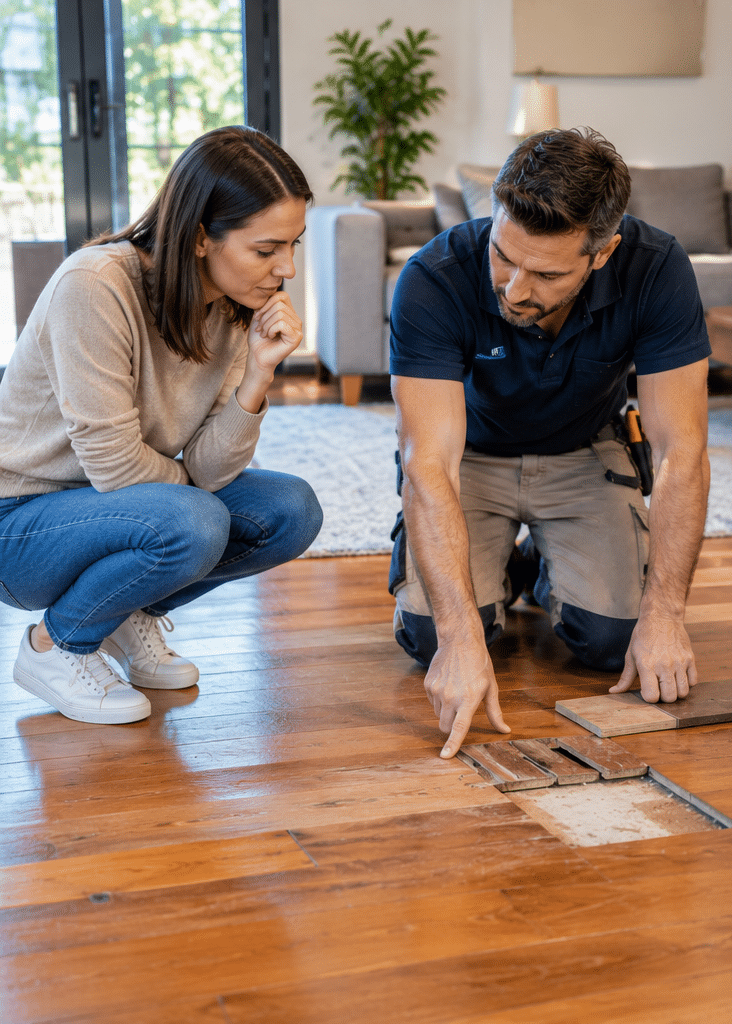
For example, boards affected by significant water damage, movement, rot, termites, serious cupping, loose subfloor components or major structural deterioration may require investigation and repair before refinishing.
This distinction matters because a beautiful coating cannot correct a problem beneath the boards.
The practical rule
If the issue is mainly at the surface, refinishing may be appropriate.
If the issue originates inside the boards, beneath the floor or from ongoing moisture, investigate that problem first.
ATFA specifically notes that whether damaged timber should be repaired or replaced depends on professional assessment, particularly where issues such as floods, borer damage, dry rot or termites are involved.
Floor Refinishing Service vs Recoating vs Replacement
Homeowners often use sanding, polishing, recoating and refinishing as though they mean exactly the same thing. In practice, they describe different levels of work.
| Option | Typical process | Best suited to | Material removed | Relative disruption |
| Recoat | Clean, prepare or lightly abrade, then apply compatible coating | Floors with worn coating but limited timber damage | Very little | Lower |
| Full refinishing | Repairs, staged sanding, detailed edging and new coating system | Scratched, uneven or substantially worn timber | More | Moderate |
| Stain and refinish | Sand to suitable surface, apply colour system and protective coats | Floors needing both restoration and colour change | More | Moderate |
| Board repair + refinish | Repair or replace individual damaged boards before sanding | Localised timber damage | Depends on repair | Moderate |
| Floor replacement | Remove or cover existing flooring and install new product | Structurally unsuitable or irreparable flooring | Existing floor may be removed | Highest |
The least aggressive method that achieves the required result is usually worth considering first.
Why? Every full sanding removes some timber.
Solid floors commonly provide more scope for future sanding than products with thin wear layers. Therefore, unnecessary sanding can reduce the number of future restoration cycles available to the floor.
Which Australian Floors Can Be Refinished?
Solid timber flooring
Solid timber is usually the most straightforward candidate.
Australian homes commonly contain species such as:
- Blackbutt
- Spotted Gum
- Australian hardwood
- Cypress Pine
- Brushbox
- Jarrah
- Tasmanian Oak
- Ironbark
Solid timber flooring can often be sanded and refinished multiple times, depending on its thickness, construction and previous sanding history.
ATFA specifically notes that the ability to re-sand and coat solid tongue-and-groove floors is one of their benefits.
Engineered timber flooring
Engineered flooring needs more caution.
An engineered board normally consists of a real timber surface layer over other supporting layers. Whether it can be sanded depends greatly on the thickness of that upper timber layer and the product’s construction.
A thick wear layer may permit sanding.
A very thin one may not.
Consequently, do not assume an engineered floor can undergo the same sanding process as a traditional solid hardwood floor.
Parquetry
Many traditional solid-timber parquet floors can be restored successfully.
However, parquetry requires careful sanding technique because blocks can have grain travelling in different directions.
Aggressive sanding in a single direction can therefore leave visible scratching.
Bamboo
Bamboo products vary significantly in construction.
Although some can be sanded and recoated, others require specialised treatment. ATFA maintains separate technical guidance specifically addressing sanding and refinishing bamboo flooring, which illustrates why product identification matters before machinery touches the surface.
Laminate flooring
Laminate should not be confused with timber.
Its decorative surface is generally not a thick layer of natural wood designed for conventional sanding. Sanding can destroy that surface.
Therefore, replacement is commonly more appropriate when laminate becomes heavily worn or damaged.
Hybrid and vinyl flooring
These products are also generally outside the traditional timber refinishing process.
Surface scratches may sometimes be managed using manufacturer-approved maintenance products, but they should not automatically be treated like solid hardwood.
How a Professional Floor Refinishing Service Works
Australian timber-flooring guidance describes sanding and finishing as a staged process rather than one aggressive pass with a sanding machine. WoodSolutions also explains that timber floor sanding normally progresses through multiple stages, beginning with levelling and moving toward finer preparation.
A typical professional workflow looks like this.
1. Inspect the floor
The contractor identifies:
- timber or flooring type
- current coating
- obvious damage
- exposed nails or fixings
- gaps
- previous repairs
- moisture concerns
- staining
- floor flatness
- remaining sandable material
This is one of the most important stages.
For example, repeatedly sanded older floorboards may have less material remaining above the tongue-and-groove joint than they originally had.
2. Define the required outcome
Next, discuss what you actually want to change.
Do you want:
- the original timber colour restored?
- scratches reduced?
- a different stain?
- lower sheen?
- greater wear resistance?
- easier cleaning?
- a faster-return-to-service system?
These goals affect the preparation and coating specification.
3. Repair where necessary
Before sanding, loose boards, protruding fixings or damaged sections may need attention.
Minor gaps or nail holes may also require appropriate filling.
The goal is to create a stable surface before finishing begins.
4. Protect adjoining areas
Doors, furniture and adjoining spaces may need protection or isolation.
Professional dust collection greatly reduces airborne sanding dust, although “dustless” should not automatically be interpreted as absolutely zero dust.
5. Carry out the initial sanding
The first sanding stages remove deteriorated finish and correct the surface.
A coarse abrasive may be required for heavily coated or uneven floors. However, the exact abrasive sequence should be chosen for the floor rather than applied as a universal formula.
6. Refine the sanding
Later sanding passes use finer abrasives to remove marks left by earlier stages.
This progressive approach is important.
If coarse sanding marks remain in the timber, applying a glossy finish can make them more visible rather than hide them.
7. Sand edges and detailed areas
Large floor machines cannot reach every location.
Edges, corners and areas around architectural details need separate equipment and careful blending with the main floor.
8. Perform final surface preparation
Before coating, residual dust and contamination must be removed.
WoodSolutions specifically highlights cleaning before sanding and explains that dirt, grit and debris can cause deep or uneven scratching if they remain on the floor.
9. Apply the coating system
Depending on the system, this may involve:
- sealer
- stain or colour treatment
- base coat
- additional protective coats
- intermediate abrasion or buffing where specified
Always treat the coating manufacturer’s instructions as part of the specification.
10. Allow curing before normal use
Dry does not always mean fully cured.
A floor may be suitable for cautious foot traffic before it is ready for furniture, rugs or heavy use.
Consequently, ask for separate guidance covering:
- walking
- replacing furniture
- putting rugs down
- cleaning
- pets
- heavy equipment
Why Sanding Technique Matters in Floor Refinishing
Sanding is not simply about removing the old coating.
Its purpose is to create a flat, consistently prepared surface suitable for the new finish.
ATFA’s solid timber flooring specification describes sanding as producing a flat surface suitable for the specified coating system and conducive to minimising appearance defects.
The challenge is balancing correction with preservation.
Sand too little and scratches, coating or unevenness may remain.
Sand too aggressively and unnecessary timber is removed.
A practical flooring principle is therefore:
Remove enough material to achieve the required surface, but no more than necessary.
Timber hardness also affects the process.
For instance, dense Australian hardwoods may behave differently under an abrasive compared with softer species such as Cypress Pine.
Likewise, old coatings can respond differently from modern coating systems.
Therefore, experience with the particular timber and coating matters.
For broader Australian technical information about timber-floor construction and finishing, see the WoodSolutions timber flooring design guide.
Choosing a Finish for Your Floor Refinishing Service
The final coating affects far more than appearance.
It influences:
- wear characteristics
- maintenance
- colour
- sheen
- drying time
- odour
- repairability
- feel underfoot
Matte finish
Matte finishes produce relatively little reflection.
They can work particularly well in contemporary interiors and may make minor surface marks less visually obvious than high-gloss coatings.
Satin finish
Satin sits between matte and high gloss.
For many residential settings, it provides a practical balance of visible timber character and moderate sheen.
Gloss finish
Gloss creates strong light reflection.
It can produce a striking formal appearance. However, scratches, dust and surface imperfections may also become more noticeable under reflected light.
There is no universally “best” sheen.
Instead, consider the appearance, lighting conditions and traffic level of the room.
Water-Based, Solvent-Based and Other Finishing Systems
Floor coatings vary considerably.
One increasingly common option is water-based polyurethane.
Reasons people may consider modern water-based systems include:
- comparatively low odour options
- relatively quick drying products
- clear appearance
- availability in several sheen levels
- lower-VOC formulations
However, “water-based” does not mean that every product has identical performance or environmental characteristics.
Always look at the specific product data.
Similarly, solvent-based systems may offer particular application or appearance characteristics but can produce stronger odours and different VOC considerations.
The right decision depends on the floor, building use, desired appearance and coating specification.
Therefore, ask your refinisher exactly which product is proposed rather than accepting a description such as “premium polish”.
Why Dust Control Matters During Floor Refinishing
Dust control is not only about avoiding messy furniture.
Mechanical sanding generates wood dust.
Safe Work Australia recognises wood dust as an airborne workplace hazard and recommends controlling hazardous airborne contaminants at the source where reasonably practicable. Engineering controls such as dust extraction are higher in the control hierarchy than relying solely on personal protective equipment.
Professional sanding equipment connected to effective extraction can therefore provide two practical benefits:
- reducing dust migration around the property; and
- helping control worker exposure at the source.
Safe Work Australia’s case study on woodworking specifically discusses fitting dust-generating processes with extraction systems and maintaining those controls.
More information, see Safe Work Australia guidance on managing airborne contaminants and occupational lung risks.
For homeowners, the key questions are straightforward:
- What dust extraction equipment will be used?
- Will adjoining rooms be isolated?
- How will residual dust be cleaned?
- Do I need to remove sensitive belongings beforehand?
For workplaces, the contractor or business should also address applicable WHS controls and site requirements. Any permits, inductions, body-corporate permissions or similar items are administrative matters that should be confirmed with the relevant property manager, regulator or qualified professional where applicable; this article is not legal advice.
How Long Does a Floor Refinishing Service Take?
There is no universal number of days.
The programme depends on factors including:
- floor area
- floor condition
- repairs
- timber type
- existing finish
- staining requirements
- number of coating stages
- product drying conditions
- ventilation
- weather and humidity
- site access
- residential versus commercial use
A small room with a straightforward floor can obviously be simpler than a large commercial property requiring repairs and multiple work stages.
Furthermore, drying time between coats is different from full cure time.
Therefore, instead of asking only:
“When will the contractor finish?”
also ask:
“When can the floor safely return to each type of use?”
That produces much more useful information.
What Affects Floor Refinishing Cost in Australia?
Floor refinishing is commonly quoted according to floor area, but square metres are only part of the calculation.
1. Total floor area
Larger floors require more labour, abrasive material and coating.
2. Existing floor condition
A relatively flat floor with a worn coating is different from one with deep scratches, exposed fixings or damaged boards.
3. Repairs
Individual board repair or replacement adds labour and material.
4. Existing coating
Some coating systems are easier to remove than others.
5. Staining
Changing the colour usually introduces additional preparation, testing and application stages.
6. Stairs and detailed areas
Stairs, edges, small landings and complex architectural areas often involve more detailed work per square metre than a large open room.
7. Coating specification
Different finishes have different material costs and application requirements.
8. Access
Difficult access can affect setup and equipment movement.
9. Commercial scheduling
After-hours or staged work may affect project planning.
Therefore, avoid choosing a service based solely on the lowest square-metre figure.
A meaningful quotation should clearly identify what is included.
10-Point Floor Refinishing Service Checklist
Before approving a project, work through this checklist.
- Confirm the flooring type. Determine whether it is solid timber, engineered timber, parquetry, bamboo, laminate or another product.
- Ask whether it has been sanded before. Previous sanding can influence the remaining usable thickness.
- Identify the existing coating. Compatibility can affect preparation and recoating.
- Discuss damaged boards. Confirm which defects can be sanded and which require repair.
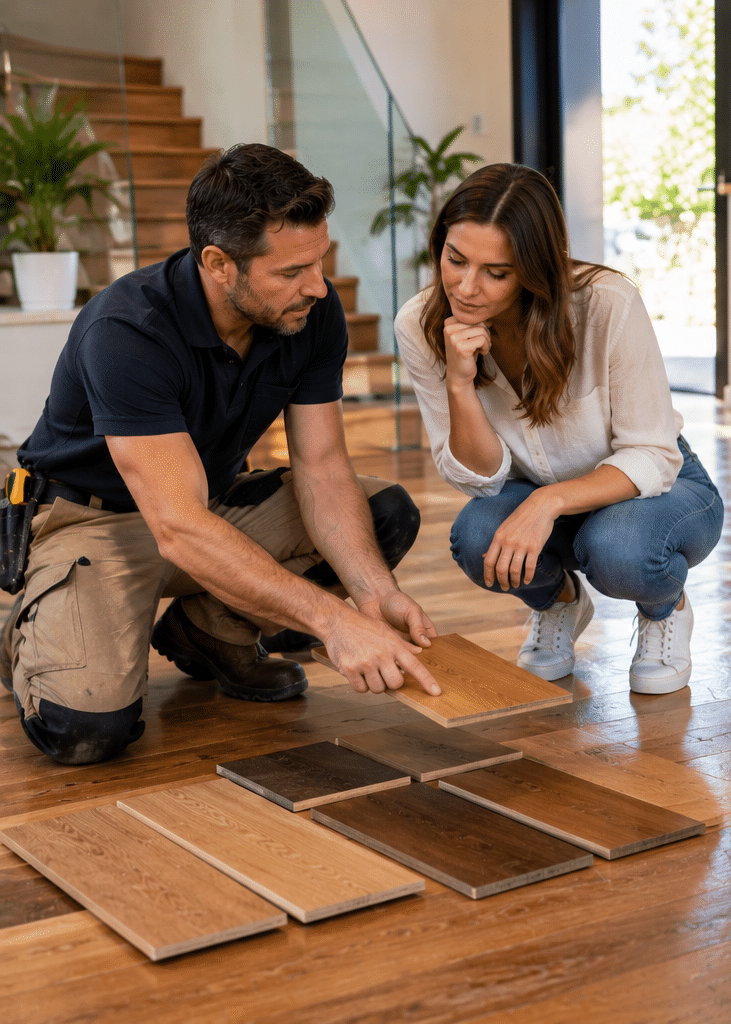
- Choose the desired colour. Decide whether you want natural timber or a stain.
- Choose the sheen level. Compare matte, satin and gloss rather than selecting from a name alone.
- Request coating details. Ask for the product/system being proposed.
- Ask about dust extraction. Find out how sanding dust will be controlled.
- Confirm return-to-service times. Ask separately about walking, furniture, rugs and cleaning.
- Get scope and exclusions in writing. Ensure repairs, sanding, coats, staining and preparation are clearly identified.
This checklist helps compare quotations on equivalent scope rather than price alone.
Residential Floor Refinishing
In homes, refinishing is commonly used for living rooms, bedrooms, hallways, dining areas and other timber surfaces.
A residential project should account for normal household concerns such as:
- children
- pets
- furniture
- indoor air
- access to bedrooms
- kitchen access
- adjoining carpet
- skirting
- stairs
Planning becomes particularly important if the floor passes through the centre of the home.
For example, if all bedrooms open onto the area being coated, ask how access will work while the coating dries.
Commercial Floor Refinishing Service
Commercial floors introduce different priorities.
A café, school, hall, retail shop, office or sports facility may experience substantially greater traffic than a bedroom.
Consequently, commercial refinishing may need to consider:
- opening hours
- staged access
- foot traffic
- chair movement
- trolleys
- cleaning regimes
- slip characteristics
- downtime
- maintenance planning
- coating durability
The coating should be selected according to the actual environment rather than simply because it produces the desired shine.
Commercial operators should also coordinate applicable workplace safety controls, access permissions and site-management requirements with the appropriate professionals.
Preparing Your Property for Floor Refinishing
Preparation can make the project much easier.
Ask your contractor exactly what they expect you to do, because requirements differ.
Common preparations include:
- removing furniture
- lifting movable rugs
- clearing objects from the floor
- securing fragile belongings
- planning alternative room access
- organising pets
- discussing refrigerators or heavy appliances
- identifying alarm systems sensitive to dust
- informing neighbours where necessary
- arranging building access
- confirming power availability
Do not independently remove fixed appliances or structural elements unless appropriately qualified to do so.
Also discuss curtains, blinds, electronics and other dust-sensitive belongings.
Even with effective dust extraction, preparation remains sensible.
How to Choose a Floor Refinishing Service
A professional-looking website is useful, but it should not be your only test.
Ask practical technical questions.
What type of flooring do I have?
A competent contractor should be prepared to identify or investigate the flooring before proposing aggressive sanding.
Does it need full sanding?
Not always.
Ask whether recoating could achieve the goal with less material removal.
How will you deal with damaged boards?
You want to know whether damage will be repaired, replaced, filled, sanded or left visible.
What sanding process will be used?
The exact abrasive sequence can vary. However, the contractor should be able to explain how the surface progresses from correction to final preparation.
What coating are you proposing?
Ask for more than “polyurethane”.
Request the actual product or coating system and ask why it suits your floor.
How do you control dust?
Look for practical extraction and isolation methods rather than vague assurances.
What will the finished floor look like?
Discuss natural colour, staining, sheen and the visibility of existing character such as nail holes or older repairs.
What is excluded from the quote?
For example:
- furniture removal
- board replacement
- stair work
- staining
- subfloor repairs
- skirting repairs
- appliance movement
A clear scope reduces misunderstandings.
Common Floor Refinishing Mistakes to Avoid
Mistake 1: Assuming every timber-looking floor can be sanded
Engineered, laminate, hybrid and bamboo products have different constructions.
Identify the product first.
Mistake 2: Sanding when recoating would be enough
Full sanding should have a purpose.
If only the surface coating needs renewal and compatibility can be established, a less invasive treatment may sometimes be appropriate.
Mistake 3: Ignoring moisture problems
Do not seal over an unresolved moisture issue.
Find the cause first.
Mistake 4: Choosing only by gloss level
Appearance matters, but so do wear, maintenance and product compatibility.
Mistake 5: Expecting sanding to remove every mark
Some stains or damage may penetrate more deeply than can safely be sanded.
A skilled refinisher should explain realistic limitations before starting.
Mistake 6: Moving furniture back too soon
Coating cure progresses after application.
Follow the product-specific return-to-service instructions.
Mistake 7: Comparing quotes with different scopes
A low quote for sanding and one coating cannot fairly be compared with another including repairs, multiple coating stages and detailed preparation.
Read what is actually included.
Maintaining Your Floor After Refinishing
Good maintenance can extend the useful life of the coating and may delay the need for another major sanding.
Remove grit
Dirt and grit under footwear can act like an abrasive.
Entry mats can help reduce the amount carried across the floor.
Use suitable furniture protection
Felt or other appropriate protective pads beneath furniture can reduce scratching.
Check them periodically because grit can become embedded.
Clean spills promptly
Avoid leaving moisture sitting on timber unnecessarily.
Follow the coating manufacturer’s cleaning guidance
Do not assume every household cleaner is appropriate.
Certain chemicals can leave residue or affect a coating.
Avoid excessive water
Timber flooring generally should not be saturated during cleaning.
Watch high-traffic areas
Entryways and corridors may show wear earlier than the rest of the room.
Addressing coating wear before bare timber is exposed may sometimes make maintenance easier.
Consider maintenance recoating
A recoat performed at the appropriate time may renew protection without requiring a complete sand back to bare timber.
The key is timing.
Once heavy wear has penetrated through the coating and affected the timber, more substantial restoration may be required.
People Also Ask About Floor Refinishing Service
Is floor refinishing the same as floor sanding?
Not exactly. Sanding is one possible stage within a broader floor refinishing service. Refinishing can also include inspection, repairs, detailed preparation, staining, coating and after-care, while some lightly worn floors may be refinished through abrasion and recoating without a complete sand back.
Can old timber floors be refinished?
Many solid timber floors can be refinished if sufficient sound timber remains and there are no unresolved structural or moisture problems. Australian timber-flooring guidance recognises re-sanding and recoating as a benefit of solid timber flooring, but an inspection should determine whether a particular floor is suitable.
Can engineered timber floors be refinished?
Some can, but not all. It depends mainly on the construction and thickness of the real-timber wear layer, so the product should be identified before sanding begins.
Does floor refinishing remove deep scratches?
Sanding can remove or significantly reduce many scratches, but a very deep mark may extend beyond the amount of timber that can safely be removed. The contractor should assess deep damage before promising a completely invisible repair.
Is floor sanding very dusty?
Sanding creates wood dust, but professional extraction can substantially control dust at its source. Safe Work Australia specifically recognises dust extraction as an important engineering control for dust-generating woodworking processes.
Floor Refinishing Service Q&A
1. How can I tell whether my floor needs recoating or complete refinishing?
Look at whether wear is limited to the protective coating or has progressed into the timber. Dullness and relatively light surface wear may potentially suit maintenance recoating, whereas exposed timber, significant scratches, uneven old finish and major staining are stronger reasons to investigate full sanding.
A professional inspection remains the safest way to decide because coating compatibility also matters.
2. Will refinishing make an old floor look completely new?
Not necessarily, and that is not always the goal.
Refinishing can dramatically improve surface consistency and protection, but older timber may retain features such as colour variation, nail holes, repaired boards or deeper stains. Those features can form part of the floor’s character.
Discuss what will remain visible before work starts.
3. Can I change the colour during refinishing?
Often, yes, where the timber and coating system are suitable.
Stains, washes and other colour treatments can alter the appearance of prepared timber. However, species respond differently, so sample testing is valuable before treating a complete room.
Natural variation between boards will also remain visible.
4. What should be included in a professional floor refinishing quote?
Ideally, the written scope should state the area, preparation, repairs included, sanding or abrasion method, staining if applicable, coating system, number of application stages, expected access restrictions and significant exclusions.
That makes it easier to compare providers fairly.
5. When should timber be replaced instead of refinished?
Replacement may deserve consideration when the floor has insufficient material remaining for safe sanding, widespread structural deterioration, severe moisture damage, extensive rot or another problem that surface restoration cannot correct.
Individual damaged boards may sometimes be replaced without replacing the entire floor, so obtain an assessment before assuming a complete new floor is necessary.
Conclusion: Restore the Floor You Already Have
A well-planned floor refinishing service is more than sanding timber until it looks lighter and applying a coat of polish. The process starts with understanding the floor, deciding how much restoration is actually necessary and preparing the surface for a compatible protective finish.
For solid Australian timber floors, that may involve staged sanding, edge work, repairs and a complete new coating system. For a floor with only coating wear, a maintenance recoat may be more appropriate. Meanwhile, engineered timber, bamboo and other products require product-specific assessment before sanding.
The most useful questions are therefore not simply, “How much per square metre?” or “How shiny will it be?”
Ask instead:
- What flooring do I have?
- Does it need full sanding?
- How much material can safely be removed?
- What coating will be used?
- How will dust be controlled?
- Which defects will remain?
- When can the floor return to normal use?
- What maintenance will protect the new finish?
Those questions help you make a decision based on the actual condition and construction of your floor.
For homeowners, property managers and businesses seeking professional timber restoration in Brisbane and South-East Queensland, explore Enviro Floors timber floor sanding, polishing and refinishing services. The company lists services including sanding, polishing, recoating, parquetry, deck restoration and commercial timber-floor work.