
post
Floor Polishing: A Complete Guide for Australian Homes

If you are researching floor polishing, you may be trying to work out whether your existing floor can be restored, what polishing actually involves, which finish is suitable, and whether professional treatment is worth the investment. In Australian homes and commercial spaces, the term “floor polishing” can describe several different processes, depending on whether the surface is timber, concrete, terrazzo, stone or another hard flooring material.
The first important point is that polishing is not one universal treatment. Timber floor polishing may involve buffing and recoating a previously finished surface, while concrete polishing can involve mechanical grinding through several stages to refine and densify the surface. Stone polishing is different again.
Therefore, the right process depends on the flooring material, its existing condition and the result you want. This guide explains the main approaches in practical Australian English, with particular attention to preparation, finishes, maintenance, costs, dust control and choosing an appropriate professional service.
Floor polishing is a professional process used to improve the appearance, smoothness and protection of suitable hard flooring surfaces. Depending on the material, it can involve mechanical abrasion, progressively finer polishing, cleaning, sealing or recoating to create a durable, easier-to-maintain finish.
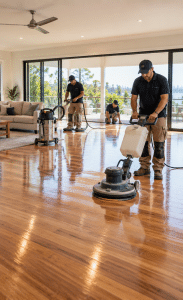
Table of Contents
- What Is Floor Polishing?
- Why Do Australian Property Owners Polish Floors?
- Floor Polishing for Different Materials
- How Timber Floor Polishing Works
- Concrete Floor Polishing Explained
- Stone and Terrazzo Floor Polishing
- Floor Polishing vs Sanding
- Choosing the Right Finish
- How Much Does Floor Polishing Cost?
- What Affects Floor Polishing Cost?
- Preparing Your Property for Floor Polishing
- Dust, Safety and Australian Requirements
- DIY vs Professional Floor Polishing
- Comparison Table: Polishing Options
- Floor Polishing Checklist
- Maintenance After Floor Polishing
- People Also Ask
- Expert Q&A
- Conclusion
What Is Floor Polishing?
Floor polishing is a broad term rather than a single technique.
The process generally involves using mechanical equipment, abrasives, polishing compounds or coatings to improve a floor’s surface. However, the exact method changes according to the material.
For example:
- Timber may be lightly abraded, buffed and recoated.
- Concrete may be mechanically ground and polished through progressively finer stages.
- Natural stone may be honed or polished to refine its surface.
- Terrazzo may be ground and polished to expose and refine its aggregate.
- Some resilient floors may receive specialist cleaning and polishing products rather than mechanical grinding.
Consequently, the first question should always be:
What type of floor do I have?
A process that is appropriate for concrete may be completely unsuitable for timber. Likewise, a stone polishing process should not automatically be applied to a coated timber floor.
Polishing is not simply making a floor shiny
A glossy appearance is only one possible outcome.
Depending on the material and system selected, polishing may be intended to:
- Refine the surface.
- Reduce visible minor imperfections.
- Improve appearance.
- Restore a worn finish.
- Increase ease of routine cleaning.
- Improve resistance to everyday wear.
- Create a particular level of sheen.
- Prepare a surface for sealing or another protective treatment.
A matt or satin surface can be polished successfully. Therefore, “polished” does not necessarily mean “high gloss”.
Why Do Australian Property Owners Polish Floors?
Flooring receives constant use.
Shoes, furniture, pets, grit, spills and general foot traffic gradually affect the surface. However, replacing an entire floor is not always necessary.
Where the underlying material remains suitable, polishing or refinishing can sometimes restore its appearance and provide another period of useful service.
Appearance
The most obvious reason is visual improvement.
A tired surface can develop dull areas and inconsistent sheen. Proper preparation and polishing can create a more uniform appearance.
However, expectations need to remain realistic.
Polishing does not necessarily remove deep structural damage. Cracks, severe stains, movement, damaged boards or underlying moisture problems may require separate treatment.
Easier routine maintenance
Smooth, properly finished hard surfaces can be relatively straightforward to clean.
CHOICE describes hard flooring options as generally durable and easy to clean, while also noting that different materials have different maintenance requirements. Its guidance on timber floors, for example, distinguishes routine maintenance from more substantial sanding and refinishing.
The important point is that polishing is not a substitute for regular cleaning.
Instead, it should form part of a broader maintenance plan.
Extending the useful life of suitable flooring
Maintaining an existing floor can sometimes be preferable to replacing it.
The environmental and financial implications depend on the material, existing condition, preparation required and products used. Durable flooring can potentially remain in service for many years when it is maintained appropriately.
Nevertheless, polishing should not be used to disguise a serious underlying defect.
If moisture is entering from below, for example, polishing the top surface will not resolve the source.
Floor Polishing for Different Materials
Before choosing a service, identify the flooring material.
Timber floor polishing
Timber is one of the most commonly associated materials when homeowners search for floor polishing services.
Depending on its condition, timber may require:
- Cleaning.
- Buffing.
- Abrasion.
- Spot preparation.
- Recoating.
- Full sanding and refinishing.
A floor with an intact coating and relatively minor wear may need less intervention than one with deep scratches or damaged coating.
CHOICE notes that high-traffic timber areas may need buffing and recoating periodically, while significant scratches can require more extensive sanding.
Concrete floor polishing
Concrete polishing is a fundamentally different process.
A professional may use diamond tooling to progressively grind and refine the concrete surface. The sequence can include coarse grinding, intermediate stages and increasingly fine polishing.
The finished appearance depends on factors such as:
- Concrete composition.
- Aggregate exposure.
- Existing surface condition.
- Hardness.
- Previous coatings.
- Desired level of exposure.
- Polishing sequence.
- Densification.
- Sealing or protective treatment.
Not every concrete slab will produce the same appearance.
That is why photographs of another property should not be treated as a guarantee of the result.
Stone floor polishing
Natural stone can include materials such as marble, granite, limestone and other products.
Different stones have different characteristics.
Some require honing before polishing. Others may require specific compounds or diamond abrasives.
The correct process depends on the stone’s composition and existing finish.
Terrazzo polishing
Terrazzo generally contains a binder with decorative aggregate.
Restoration may involve grinding to expose or level the surface, followed by progressively finer polishing stages and, where appropriate, sealing.
Older terrazzo can be particularly valuable to restore because removing it may mean losing an original feature of the building.
How Timber Floor Polishing Works
Timber requires a different approach from concrete or stone.
Step 1: Inspection
First, the floor should be assessed.
Important questions include:
- Is it solid timber?
- Is it engineered timber?
- Is it parquetry?
- What coating is currently present?
- How worn is the coating?
- Are there deep scratches?
- Are boards loose?
- Are there stains?
- Has the floor previously been sanded?
This assessment determines whether polishing, recoating or sanding is appropriate.
Step 2: Cleaning and preparation
Dirt, grit and other contaminants should be removed before mechanical treatment begins.
Furniture may need to be removed or relocated.
Step 3: Surface preparation
If the existing coating is suitable, a professional may mechanically abrade the surface to prepare it for a new coating.
The objective is controlled preparation rather than unnecessary removal of timber.
Step 4: Repairs
Some defects cannot be corrected through polishing alone.
Loose boards, deep gouges or damaged sections may require repairs.
Step 5: Coating
A compatible finish can then be applied according to the product manufacturer’s requirements.
The choice may affect:
- Colour.
- Sheen.
- Wear characteristics.
- Cleaning requirements.
- Drying time.
- Curing time.
Step 6: Curing
One of the most common mistakes is treating a floor as fully ready for normal use as soon as the surface feels dry.
Drying and curing are not necessarily the same thing.
Homeowners should follow the coating manufacturer’s and contractor’s instructions about foot traffic, furniture, rugs and cleaning.
Concrete Floor Polishing Explained
Concrete polishing is often a multi-stage mechanical process.
Initial assessment
The contractor should assess the existing slab.
This may include looking for:
- Cracks.
- Previous repairs.
- Coatings.
- Glue residue.
- Uneven areas.
- Surface contamination.
- Aggregate distribution.
- Moisture-related issues.
Grinding
Coarse diamond tooling is used to remove unsuitable surface material and establish the required level of flatness.
The amount of material removed depends on the project.
Some floors are polished with minimal aggregate exposure, while others are ground deeper to reveal more aggregate.
Honing
Finer tooling follows the initial grinding stages.
Honing reduces the visible scratches created by coarser abrasives and progressively refines the surface.
Densification
Concrete may be treated with a chemical densifier.
In simple terms, a densifier reacts with components in the concrete to help create a harder, less porous surface.
The suitability and exact application depend on the concrete and the product.
Polishing
Finer diamond abrasives progressively refine the surface.
The final appearance depends on the grit sequence and other factors.
Protection
A concrete floor may require a protective treatment depending on its intended use.
A professional should explain whether the proposed system relies on the polished concrete itself, a densifier, a sealer or another protective product.
Floor Polishing and Brisbane’s Climate
Australian conditions vary considerably.
Brisbane’s subtropical climate can involve warm temperatures and periods of high humidity, while other Australian cities have very different environmental conditions.
These factors matter because coatings, adhesives, timber and other flooring materials can respond to temperature and moisture.
For timber, moisture movement is particularly important.
A floor may develop gaps or movement as environmental conditions change. Consequently, a polishing or recoating project should consider whether observed defects are simply surface wear or signs of a broader issue.
For concrete and other mineral surfaces, moisture can also affect coatings and treatments.
Therefore, the right question is not simply:
“Can this floor be polished?”
It is:
“Is this floor in a suitable condition for the proposed polishing system?”
Floor Polishing vs Sanding
The terms are sometimes used interchangeably, but they can describe different levels of work.
Sanding
Sanding generally removes a controlled amount of material.
With timber, this can remove old coatings and surface defects and prepare the wood for refinishing.
It is therefore a more substantial intervention.
Polishing
Polishing usually focuses on refining an existing surface or finish.
However, the exact meaning depends on the flooring material.
Concrete polishing can involve substantial grinding before fine polishing begins.
Timber polishing may involve much less material removal.
So, when comparing quotations, ask the contractor to describe the actual process rather than relying on the label.
Choosing the Right Finish
The desired finish should be discussed before work begins.
Matt
Matt finishes offer limited reflection and can provide a softer visual appearance.
They may also make minor surface variations less visually obvious than a highly reflective finish.
Satin
Satin is a common middle-ground option.
It provides some sheen without creating the strong reflection associated with high-gloss finishes.
Gloss
Gloss produces a more reflective appearance.
It can look striking in the right setting, but reflections may also make scratches, dust or surface irregularities more noticeable.
Natural appearance
Some homeowners want the floor to look as close as possible to its natural material.
In timber, a clear or lightly coloured finish may be selected for this reason.
In concrete, the natural variation of aggregate and the slab itself can form part of the design.
There is no universally correct finish.
The right choice depends on the property, lighting, traffic and maintenance expectations.
How Much Does Floor Polishing Cost?
There is no reliable single Australian price for floor polishing.
Online estimates can be useful for initial research, but they should not replace an individual assessment.
A quotation can vary substantially according to:
- Floor area.
- Flooring material.
- Existing condition.
- Amount of grinding or preparation.
- Number of rooms.
- Access.
- Furniture.
- Repairs.
- Coating requirements.
- Desired finish.
- Number of treatment stages.
- Location.
- Project complexity.
For example, two properties with the same floor area can require very different amounts of preparation.
One might have a relatively clean surface requiring light preparation.
Another might have old coatings, repairs, deep scratches and difficult access.
Therefore, a simple price-per-square-metre comparison can be misleading if the scopes of work are different.
Ask what the quotation includes
Before accepting a quotation, check whether it covers:
- Preparation.
- Grinding or sanding.
- Edge work.
- Repairs.
- Coatings.
- Sealing.
- Dust extraction.
- Cleaning.
- Furniture movement.
- Additional coats.
- Final inspection.
Also ask about exclusions.
A transparent quotation should make it easier to understand what you are paying for.
What Affects Floor Polishing Cost?
Floor condition
Heavily worn floors generally need more preparation.
Existing coatings
Some coatings or residues require additional mechanical preparation.
Repairs
Cracks, damaged timber, loose sections and other defects can add work.
Floor material
Concrete, timber, terrazzo and stone require different equipment, abrasives and techniques.
Access
Stairs, narrow doorways, occupied properties and restricted access can affect productivity.
Desired finish
A basic maintenance treatment is different from a multi-stage restoration intended to achieve a highly refined appearance.
Project size
Larger areas can create economies of scale, but the relationship is not always linear.
Location
Labour, transport and local operating conditions can influence quotations across Australia.
For these reasons, treat any published price as an estimate unless it is specifically based on your floor.
Preparing Your Property for Floor Polishing
Preparation is one of the easiest ways to make a flooring project run more smoothly.
Before the work begins
Confirm:
- Which rooms will be treated.
- What furniture must be removed.
- Whether the contractor moves furniture.
- Where equipment will enter.
- How long access will be restricted.
- How much noise is expected.
- Whether ventilation is required.
- When normal foot traffic can resume.
- When furniture can return.
- When rugs can be placed.
- How the completed floor should be cleaned.
Remove fragile objects
Vibration and equipment movement can affect items close to the work area.
Remove fragile decorative objects where practical.
Plan for pets
Pets should generally be kept away from active work areas.
Dust, equipment, wet coatings and unfamiliar noise can create unnecessary risks.
Ask the contractor about safe re-entry.
Plan for business premises
Commercial sites need additional planning.
Consider:
- Customer access.
- Staff movement.
- Cleaning schedules.
- After-hours work.
- Fire exits.
- Ventilation.
- Furniture relocation.
- Delivery access.
Administrative arrangements should be confirmed with the relevant property manager, building manager or responsible workplace representative.
Dust, Safety and Australian Requirements
Dust management is particularly important where mechanical grinding or polishing is involved.
The type of dust depends on the material being worked.
Timber creates wood dust.
Concrete, masonry, stone and other silica-containing materials can create respirable crystalline silica (RCS) when mechanically processed.
WorkSafe Queensland explains that high-energy processes including grinding and polishing can generate RCS when silica-containing materials are involved. (WorkSafe Queensland: respirable crystalline silica)
This is an important distinction.
Polishing a timber floor is not the same dust exposure scenario as grinding concrete or stone.
Concrete and silica dust
WorkSafe Queensland specifically provides guidance for walk-behind floor grinders used on concrete and other silica-containing materials. Recommended engineering controls include suitable water delivery or a commercially available vacuum dust collection system meeting specified requirements. (WorkSafe Queensland floor-grinder guidance)
For businesses undertaking this type of work, safety procedures should be based on the current requirements applying to the particular task and material.
Do not treat dust control as an optional extra
Good dust management can involve:
- Local extraction.
- Suitable industrial vacuum systems.
- Wet methods where appropriate.
- Containment.
- Correct machine setup.
- Appropriate personal protective equipment.
- Cleaning methods that do not unnecessarily re-aerosolise dust.
WorkSafe Queensland notes that dry sweeping or compressed-air cleaning can disturb settled RCS dust and put it back into the air. (WorkSafe Queensland silica guidance)
This information is general guidance rather than legal advice. Businesses should review the current WHS requirements applicable in their state or territory and obtain qualified advice where required.
DIY vs Professional Floor Polishing
Some polishing products are designed for consumer use.
However, professional mechanical polishing is a different proposition.
Large grinders and polishers require appropriate technique.
Potential advantages of DIY
DIY may offer:
- Lower labour expenditure.
- Greater control over timing.
- The ability to handle small maintenance tasks yourself.
Potential disadvantages
However, mistakes can be expensive.
A poor process can cause:
- Uneven surface preparation.
- Visible machine marks.
- Excessive material removal.
- Inconsistent sheen.
- Coating adhesion problems.
- Dust-control issues.
- Damage requiring professional correction.
Concrete polishing is particularly equipment-intensive.
The machinery, diamond tooling and dust controls can make professional work more practical for larger projects.
When professional work is worth considering
Professional treatment is particularly worth considering where:
- The floor is valuable.
- The floor is old.
- Extensive preparation is required.
- The property is large.
- The floor material is unfamiliar.
- The desired finish is highly consistent.
- Dust control is important.
- The project involves concrete, stone or terrazzo.
- You need a documented commercial work process.
Comparison Table: Polishing Options
| Flooring type | Typical treatment | Main purpose | Key consideration |
| Timber | Buffing, abrasion and recoating | Refresh and protect existing finish | Coating condition and timber depth |
| Solid timber | Sanding/refinishing or polishing | Restore worn flooring | Previous sanding and board condition |
| Concrete | Grinding, honing and polishing | Refine and harden surface | Slab condition and aggregate exposure |
| Terrazzo | Grinding and polishing | Restore decorative surface | Aggregate and binder condition |
| Natural stone | Honing/polishing | Refine appearance and surface | Stone type and existing finish |
| Coated floors | Specialist preparation and recoating | Restore protective layer | Coating compatibility |
This table is a general guide. A site assessment remains important because the same flooring category can contain very different products and conditions.
Floor Polishing Checklist
Use this checklist before booking a project:
- Identify the flooring material.
Confirm whether it is timber, concrete, stone, terrazzo or another surface. - Inspect the existing condition.
Note scratches, cracks, stains, coatings, loose sections and uneven areas. - Decide what outcome you want.
Define whether the goal is maintenance, restoration, a different sheen or a complete surface transformation. - Ask whether polishing is appropriate.
A professional should explain why the proposed treatment suits the floor. - Discuss preparation.
Confirm what sanding, grinding, cleaning or repairs are required. - Ask about dust control.
Find out what extraction or wet methods will be used where applicable. - Confirm the finish.
Discuss matt, satin, gloss or another specified appearance. - Request a written quotation.
Check inclusions, exclusions, materials and additional work. - Ask about drying and curing.
Find out when people, pets, furniture and rugs can return. - Plan access.
Clear the work area and arrange entry for equipment. - Discuss maintenance.
Ask which cleaning products and methods are recommended. - Keep product information.
Retain details of coatings, sealers or maintenance products for future reference. - Inspect the finished surface.
Review the work under natural and artificial lighting where practical. - Follow aftercare instructions.
Early maintenance can influence how well the new surface performs.
Maintenance After Floor Polishing
Polishing is not the end of the flooring-care process.
Regular maintenance helps preserve the result.
Remove grit regularly
Fine grit can act as an abrasive when walked across a hard floor.
Vacuuming or using a suitable cleaning method can help reduce this effect.
Clean spills promptly
Different flooring materials tolerate moisture differently.
Wipe spills rather than allowing them to remain on the surface.
Use compatible products
Do not assume that a household cleaner is suitable for every polished surface.
A product designed for one coating can be inappropriate for another.
Follow the manufacturer’s maintenance recommendations.
Protect high-traffic areas
Commercial and residential entrances can experience particularly high wear.
Mats can help capture grit before it reaches the main floor.
However, mats should be suitable for the particular surface and environment.
Protect furniture contact points
Felt pads or other appropriate protectors can reduce scratching caused by furniture movement.
Lift furniture rather than dragging it wherever practical.
Avoid unnecessary abrasive cleaning
Aggressive scrubbing can affect some finishes.
If a floor becomes difficult to clean, investigate the cause rather than automatically increasing cleaning intensity.
How Often Should Floors Be Polished?
There is no universal timetable.
The appropriate frequency depends on:
- Material.
- Traffic.
- Coating.
- Cleaning routine.
- Commercial or residential use.
- Environmental conditions.
- Visible wear.
Timber illustrates why a fixed schedule can be misleading. CHOICE notes that high-traffic timber areas may need buffing and recoating every three to four years, but that is not the same as saying every timber floor should undergo full sanding or polishing at that interval. (CHOICE timber flooring guidance)
Instead, inspect the floor periodically.
If the finish is still performing well, routine cleaning may be sufficient.
If wear becomes visible, discuss whether a lighter maintenance treatment or a more substantial restoration is appropriate.
Signs Your Floor May Need Professional Attention
Look for:
- Widespread dullness.
- Uneven sheen.
- Scratches through the finish.
- Staining.
- Peeling or failing coating.
- Persistent marks.
- Cracks in concrete.
- Exposed or damaged aggregate.
- Loose timber boards.
- Repeated moisture damage.
Not every symptom means the floor needs polishing.
For example, a loose timber board is a repair issue first.
Likewise, a moisture problem should be investigated before refinishing.
Questions to Ask a Floor Polishing Contractor
Before engaging a provider, ask specific questions.
“What process will you use?”
A reputable quotation should explain whether the job involves buffing, sanding, grinding, honing, polishing, sealing or recoating.
“How much material will you remove?”
This is particularly important for timber and concrete.
The answer should relate to the condition and desired outcome rather than an arbitrary amount.
“How will you control dust?”
For concrete or other silica-containing materials, ask about appropriate engineering controls.
“What finish will I receive?”
Ask for the expected sheen and, where practical, a sample or reference.
“What happens if you uncover damage?”
Clarify how additional repairs are handled.
“How long until the floor can be used?”
Ask separately about light foot traffic, normal use, furniture and rugs.
“What maintenance is required?”
A good result should come with clear aftercare information.
People Also Ask
What is floor polishing used for?
Floor polishing is used to refine, restore or protect suitable flooring surfaces. The exact process varies by material, with timber, concrete, stone and terrazzo requiring different preparation and equipment.
Is floor polishing the same as sanding?
No. Sanding generally involves removing a controlled amount of material, while polishing focuses on refining a surface. However, some polishing systems, particularly concrete restoration, can include substantial grinding before fine polishing.
How long does floor polishing take?
The timeframe depends on the floor area, material, condition, preparation, number of stages and curing requirements. A small maintenance treatment can be much quicker than a full restoration.
Is polished flooring hard to maintain?
Properly finished hard floors can be relatively straightforward to maintain, but they still require suitable cleaning and periodic care. Maintenance requirements vary according to the flooring material and finish.
Can damaged floors be polished?
Some surface damage can be reduced through polishing or refinishing. However, deep cracks, severe stains, loose boards and structural or moisture-related problems may require repairs before polishing.
Expert Q&A
1. Can floor polishing remove deep scratches?
It depends on the flooring material and depth of the damage.
Light surface scratches may be reduced through suitable preparation and polishing. Deep scratches that extend below the workable surface may require sanding, grinding, filling, repair or replacement.
The important consideration is not to remove excessive material simply to chase a defect that cannot be safely polished away.
2. Does floor polishing make a floor waterproof?
No.
A polished or sealed surface may have improved resistance to moisture, depending on the material and treatment, but this does not make the floor completely waterproof.
Timber is particularly sensitive to moisture exposure. Concrete can also absorb liquids depending on its porosity and protective treatment.
Therefore, spills should still be dealt with promptly.
3. What is the difference between polished concrete and sealed concrete?
Polished concrete is mechanically refined using progressively finer abrasives. Sealed concrete relies primarily on a protective coating or sealer applied to the surface.
A concrete floor can be sealed without being polished, while polished concrete can also use additional protective treatments depending on the specification.
The visual appearance and maintenance characteristics can therefore be quite different.
4. Can an old timber floor be polished without sanding?
Sometimes.
If the existing finish remains sound and the wear is relatively light, a maintenance treatment involving preparation and recoating may be appropriate.
However, significant scratches, damaged coating or uneven surfaces may require sanding.
A professional assessment should determine the least aggressive treatment capable of achieving the required result.
5. What should commercial property owners consider before floor polishing?
Commercial properties need to consider more than appearance.
The project may need to account for:
- Workplace access.
- Staff and customer movement.
- Noise.
- Dust.
- Ventilation.
- Equipment access.
- Slip considerations.
- Cleaning procedures.
- Cure times.
- After-hours work.
- Workplace health and safety requirements.
For concrete or other silica-containing materials, the applicable WHS controls should be established before work starts. In Queensland, WorkSafe provides specific guidance for construction tasks involving grinding and polishing silica-containing materials. (WorkSafe Queensland construction dust guidance)
Administrative matters such as contractor documentation, site inductions, insurance and workplace procedures should be treated as project administration and checked against current requirements by the responsible business or qualified adviser where necessary.
Is Floor Polishing Environmentally Preferable to Replacement?
There is no universal answer.
Restoring an existing floor can avoid the need to remove and replace an otherwise serviceable surface. However, the environmental impact of any restoration depends on the equipment, electricity, water, chemicals, coatings, waste and transport involved.
The existing material also matters.
CHOICE’s sustainability guidance notes that durable hard flooring can remain useful for longer and that maintenance and finish selection have environmental implications. (CHOICE sustainable flooring information)
Therefore, a sensible approach is to assess whether the existing floor can be restored before assuming replacement is necessary.
Getting Better Value From Floor Polishing
The best way to compare flooring services is to compare scope, not just price.
A useful quotation should tell you:
What is being done + how it will be done + which materials are used + what is included + what is excluded.
For example, one contractor may quote for light polishing and recoating, while another may quote for complete mechanical restoration.
The second price may be higher because the scope is substantially different.
Ask for clarification when quotations appear unusually different.
Be careful with guaranteed claims
Flooring contains natural variation.
Timber grain differs from board to board. Concrete aggregate varies across slabs. Stone can contain natural colour and pattern variation.
Therefore, reputable advice should explain what is realistically achievable rather than promising an identical result to a photograph.
Why Professional Assessment Matters
Floor restoration is partly technical and partly practical.
The technician needs to understand the material, but also the environment in which it is used.
A family home with children and pets has different requirements from a retail shop.
A high-traffic commercial floor has different maintenance demands from a spare bedroom.
An original timber floor in a heritage-style property may need a more conservative approach than a recently installed floor.
Likewise, polished concrete in a warehouse may be specified differently from polished concrete in a residential living area.
This is why a site assessment can be more useful than choosing a service based solely on a generic description.
Conclusion
Floor polishing can improve the appearance and serviceability of suitable flooring, but the right process depends heavily on the material and its condition. Timber, concrete, stone and terrazzo require different techniques, equipment and finishing systems.
For Australian homeowners and property managers, the most important steps are to identify the flooring material, assess its condition, establish the desired result and understand exactly what the contractor’s quotation includes.
Good preparation matters just as much as the final polishing stage. So does dust control, particularly when grinding concrete, stone or other silica-containing materials.
If your existing floor needs professional assessment or restoration, explore professional floor restoration and polishing services from Enviro Floors.


